
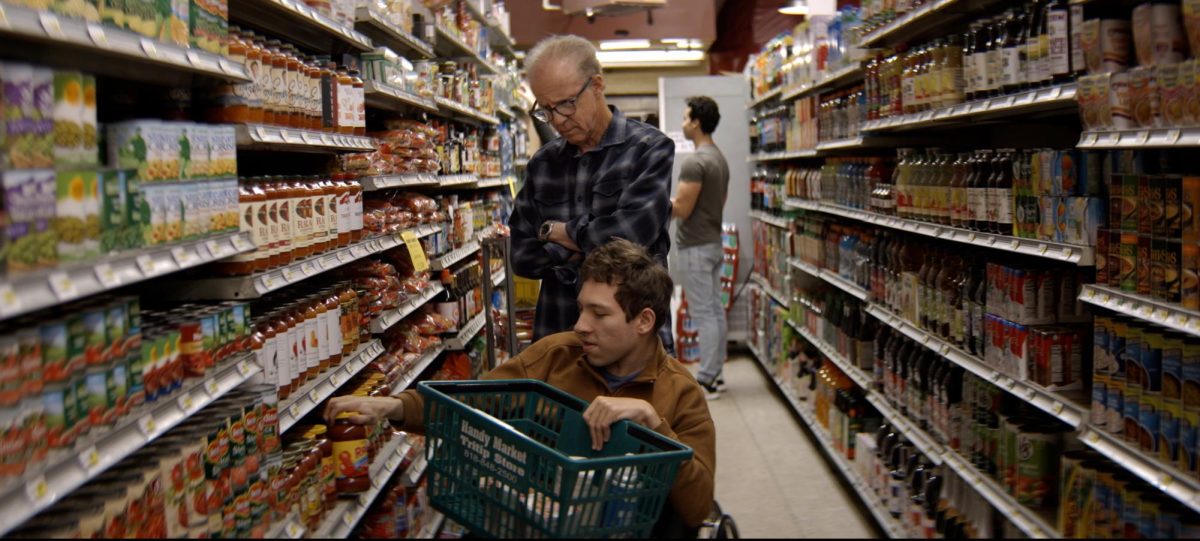
Oscar has been diagnosed with cancer. “Paper Bag Plan,” the latest film from San Francisco State University alum Anthony Lucero, inspired in part by his own life, kicks off with this distressing discovery. By the end of the night, Oscar has decided to teach his disabled son, Billy, how to cook a meal for the first time. As Billy’s primary caretaker, Oscar cannot fathom the reality the two of them now face: one where Oscar can no longer provide for Billy’s needs. Yet, Oscar races against time and trains Billy how to bag groceries, hoping to get him a job at their local corner shop.
This is an independent film in the truest sense, financed by its filmmakers and distributed at a local level, including at San Francisco’s Vogue Theater. Directed by a Bay Area local, shot and set in Oakland, “Paper Bag Plan” is a film by the Bay and, in some ways, about the Bay. The community of Oakland plays a large part in the film, while the city as a backdrop feels very natural.
Lucero’s journey toward the film, his second as director and first since 2014’s “East Side Sushi,” was not an easy one, but the results are undeniably his own. After years of working in visual effects at Industrial Light & Magic, Lucero’s projects are true reflections of his artistic pursuits. In the midst of the release of “Paper Bag Plan,” Lucero spoke at length about the journey toward his sophomore feature with Golden Gate Xpress.
Interview
(Here are the edited excerpts from our conversation.)
Hammel: Tell me a little bit about how the seed of this idea kind of came to be.
Lucero: It’s mostly inspired by my mom and the relationship between my brother Eddie. Eddie was physically, mentally disabled, so he couldn’t walk. He couldn’t talk. He needed 24/7 care from my mom. So, my mom would feed him. He could open his mouth, that’s the extent of what Eddie could do. Eddie was with us for about 47 years, thanks to my mom’s love and dedication to Eddie. So, it’s loosely based on their relationship for 47 years. It was a very loving relationship. My mom would bathe him and talk to him and they’d watch TV together, and it was a very sweet relationship. If anybody had the inside scoop of just being a fly on the wall, they would have loved just listening to my mom and Eddie talk. At least my mom would talk and Eddie would just listen. So, that’s where the seed of the story started.
Hammel: When did you know you wanted to take that seed and turn it into what the film eventually became, the specific story between father and son?
Lucero: The second half, kind of what propelled the story, was my sister, Margie. She died of cancer in 2018 and she left behind her daughter, my niece, Sarah. Sarah has Angelman syndrome, which is not Down syndrome, but it seems similar. She has the cognitive ability of maybe a 2-year-old, my niece… And I started thinking about: there must be other parents out there that have children with disabilities. What does that look like? What have they done? Who’s going to watch their child once they pass? And so, that sort of moved the story forward once my sister died.
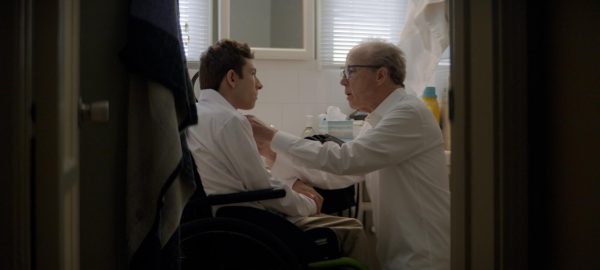
Hammel: The hyper specificity of this relationship between father and son is so touching. You get at this very terse, kind of loving and not standoffish, loaded relationship. How did that dynamic come to be?
Lucero: I think what you’re getting at is probably the father and son, they argue and then they make up and they love each other. I felt it was very real because you fight with your child, and so I wanted some of that in the film. And I think films that have characters with a disability tend to feel like these characters live in an alternate universe, alternate reality where their world is so fun. And these people that have a disability have this, I don’t know, different view of life that is beautiful. And it’s like, well, no. They deal with a lot of heartaches just like anybody else. So, I wanted to paint a little bit more of a realistic picture, and not just this film, but I think my writing in my previous film, “East Side Sushi,” there’s a level of authenticity that I like to keep. That’s part of it, right? I just want to keep it authentic and grounded in reality. It’s a movie, so it’s not a documentary that I’m making. I have to make it entertaining as well for people to watch. So, I’m always in that conflict of like, I got to keep it real and authentic, but I also have to make it watchable and entertaining for people. It’s always that tug of war as a writer when I make these films.
Hammel: What was that casting process like, and how did you eventually land on Cole Massie?
Lucero: Cole, he’s a sweetheart. I love him so much. [Billy] was always going to be an actor with a disability. I was never at any moment thinking I would hire an actor that would pretend like they’re using a wheelchair, pretend like they have cerebral palsy. That was never even a thought. It was always going to be an actor with a disability — very difficult task to find. It’s hard enough to find that actor to represent your screenplay, but then you throw in these other barriers of: now they have to have a disability. Then that percentage starts to shrink as far as actors go. My casting director, Russell Boast, specializes in actors with disabilities. So, he was the one who reached out, and he canvassed and he found about 50 actors. And we had looked at all of them. We looked at their reels and we auditioned over Zoom. Cole was the last one… And I thought, “Okay, I found my Billy,” which was scary because at that point, I told Cole that he’s got the lead role, but now “where do we find the funding” was the next thought… I did have some seed money before I cast Cole, so we had something to move forward with, but it wasn’t enough to make the entire film.
Hammel: How’d that process come about? This is such an independent film, and the scale of it is so intimate and you maximize the limitations that you have. How was the sourcing of funding?
Lucero: Oh my gosh, there were tons of limitations… The van that we were using, which was Cole’s real van, got smashed and someone drove by, hit-and-run, smashed the van while it was parked at their house. I had to rewrite a good chunk of the film because a lot of it took place in and around the van because the van was a symbol of their freedom between father and son… The film was funded mostly by my wife Ke`alohi [Lee Lucero]. We had shot the first two weeks in the home that we were renting. We shot that first, and we really didn’t have enough money to shoot the rest, but the footage inside the home was so beautiful between the two actors. My wife just knew, she said, “We have to finish this film. Somehow we have to do it.” So, she opened up her bank account, she funded it and we just finished it. Very low budget, and if you self-fund a film, like I did my last feature, it’s very difficult. Everything becomes difficult. All the equipment that you have to rent and feeding the crew, everything becomes a struggle. It is one heck of a boulder that we pushed up the hill once you self-fund it.
Hammel: How did you go about casting the lead role of Oscar?
Lucero: Lance Kinsey, if you’ve seen the “Police Academy” films, plays Proctor, which I didn’t know when I met him a decade ago. We met on the festival circuit. He had a film called “All-Stars” and I had a film called “East Side Sushi,” and we both kept meeting up at different films. “Hey Lance, how you doing?” He was such a nice guy. So I asked Lance to be in a short film, and he’s like, “Sure, I’ll do it.” But he was so easy to work with, and he had only done comedy. This is the first dramatic role for him… We had a gut feeling that he could pull this off and he could do a really good job. We just kind of knew it, so I sent him the script. It was originally written as a mother and son. What happened was we had been turned down by actresses that I had handpicked that I really loved… My wife thought, “Well, why don’t we change it to a father-son story?” Because she had not, like we were saying, not seen very many compassionate stories of fathers and sons together. So I thought, “Okay, let’s do that” … Lance Kinsey, he read the screenplay, and he’s like, “I’ll do it.” What I didn’t know at the time is that Lance had lost his wife to cancer about two years prior. So, it was a very personal film for him as well. He was pulling a lot from all the cancer treatments and he definitely pulled from, sadly, from all of that experience to play the part.
Hammel: It’s set in Oakland. What does that mean to you, and why do you set your films in the Bay?
Lucero: I was born and raised in East Oakland. Even when I went to SF State, I was taking BART back to East Oakland every day. It’s ingrained in me: where I live, where I grew up, it’s the actors that I cast, the actors that I write for were always minority groups, people of color. In this instance, someone with this disability. Coming from East Oakland really drove the type of stories that I write. I think “Paper Bag Plan” is a companion piece to “East Side Sushi” and so my third film will also tie in these characters as well. It’ll be a trilogy of films that all take place in and around Oakland.
“Paper Bag Plan” is now playing in limited release at the Vogue Theater and will play at Majestic Bay Theaters with a Q&A with Lucero on Oct. 5.