
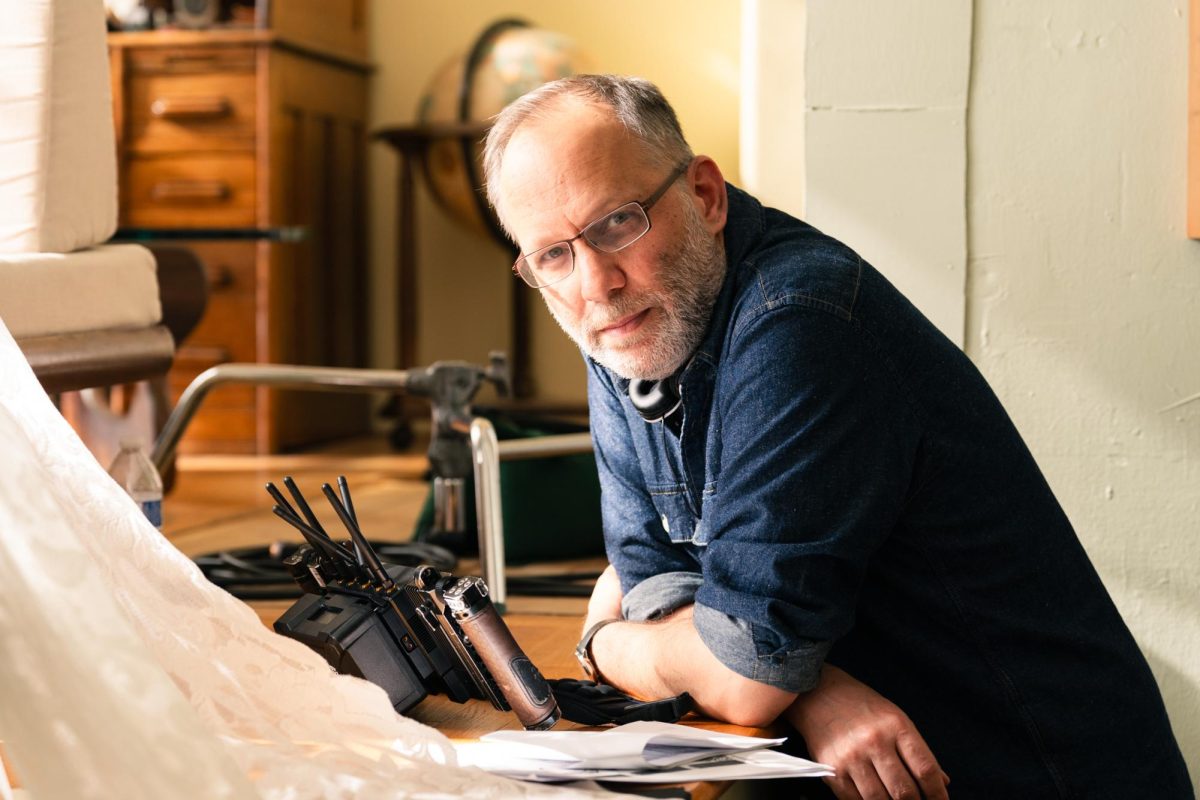
Ira Sachs is no stranger to queer art. The renowned independent filmmaker’s newest film, “Peter Hujar’s Day,” an adaptation of Linda Rosenkrantz’s book of the same name, is an exemplary entry into the pantheon of that very medium.
Rosenkrantz’s book was born from a project she started in the 1970s where she aimed to record a handful of her artist friends in the East Village, a hotspot of profound and bold creativity, and ask about their days to provide a look into the artist’s way. In the social midst of Fran Lebowitz, Allen Ginsberg and Susan Sontag, all of whom are name-dropped and whose name-drops are wryly addressed in the film, Hujar stood tall but often overlooked in his time. The prolific gay photographer’s works are some of the most striking and influential of the 70s and 80s, especially his piercing portraiture.
Hujar died of AIDS in 1987 and his work gained wider recognition after his passing. Rosenkrantz’s larger project never came to fruition and the recordings were lost, but a transcript of her day with Hujar was found decades later and she published it as a book in 2021. Sachs, a longtime admirer of Hujar, saw the book to be ripe for adaptation.
After specially screening the film at San Francisco’s Roxie Theater in early November, Sachs sat down with Golden Gate Xpress for a deep dive into the film ahead of its opening at the Roxie on Nov. 21.
Interview
(Here are the edited excerpts from our conversation.)
Hammel: Is this a film about performance?
Sachs: Interesting question. Yes. A pleasure for me [making this] film was watching what these actors would do with both the language and the silences. I was working with two British actors, asking them to transform themselves through the use of accents to Americans, which is something I’ve never done before. So by nature, it was a film about performance and transformation.
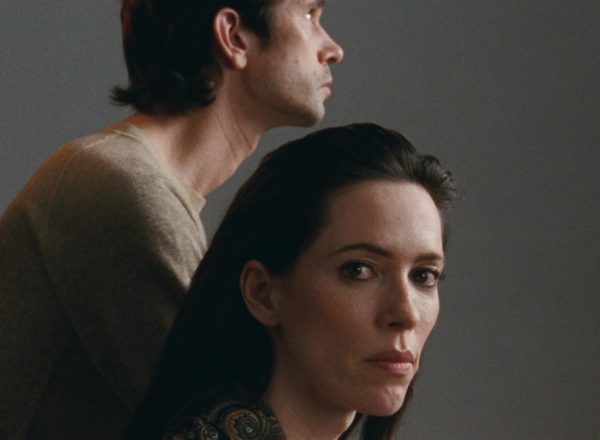
Hammel: I love the interstitials and the ellipses that are, I don’t want to say breaking the fourth wall, but that are always making you aware this is being filmed and this is being recorded in-universe. In the past, it’s being recorded and in our reality you are recording their recording. When did you first encounter Hujar’s work beyond Rosencrantz’s book?
Sachs: In the early ‘90s, I saw one show, which led to another show, which led to many books. So I’ve been familiar with his work for quite a while. I feel like his work is, for me, it’s like a lot of filmmakers; it becomes a part of my sense of self and family. I really, really know Peter Hujar’s work. I see things through Peter Hujar in a certain way, but I will say I never knew Peter Hujar. So there is also a kind of distance I have from his life biographically, personally. And I think the film contains both my intimacy with him and also my never knowing him.
Hammel: When did you come across the book and when did you know that this was something you wanted to adapt?
Sachs: I read the book in 2021 when I was filming a film called “Passages” in Paris with Ben Whishaw. And by the time I finished the book, which is pretty short, 30 or 40 pages, I thought, “I should make a movie of this with Ben.”
Hammel: What was it about working with Ben Whishaw during the shooting of “Passages”? Did you know that he was your Peter immediately?
Sachs: Definitely. I wouldn’t have made the film with anyone but Ben. The idea was to make a film of this material with him. We share a real interest in queer history, queer art making, experimental work in general. I knew that he would be down with trying to do something that would be unique and possibly a failure. He was comfortable with the possibility of failure. That’s going to be what I ask people: “Are you comfortable with the possibility of failure?”
Hammel: Did you take any inspiration from Hujar’s work when blocking and staging the film? It is so untheatrical when it could easily be very stagey, but it is so cinematic, intimate and it doesn’t feel rehearsed. I know you don’t do rehearsals, but how did you go about setting up the film? I’m sure it was a tight time frame.
Sachs: Yeah, we had plenty of time to shoot what we needed to shoot because we were also limited in that it was one location, it was two actors. There was a kind of simplicity to the framework of the project. The challenge was to expand beyond the real. So to turn something that was probably, which was most, which was certainly, let’s say, not even most likely, certainly a very stagnant conversation between two people across a table into something that would be cinematically moving and active. Really, the hardest thing was to come to the point where I gave my permission to assume that people would get from one place to the other through a cut. To trust the cut was the hardest thing.
Hammel: You’ve worked with your editor [Affonso Gonçalves] since your debut. What was it like working with him on this? Because there is a lack of a natural framing device, how did you come up with the ellipses? What was that dynamic like? It feels built in that editing process.
Sachs: Unusually, I was not watching dailies while I was shooting and I sent everything that we shot to him and then I waited about a month because he was working on three other features at the same time. What came back to me was a film that made sense. It was certainly an initial pass, but he saw in it, and also with the inclusion of Mozart’s “Requiem,” he saw both the real and also the hyper-real that I was looking for in the film. The film does narratively lay itself out because of the story he’s telling. It’s quite linear. We couldn’t, it wouldn’t allow us to move everything around backwards and forwards. We had to follow the story. So that gave us a vertebrae for the film.
Hammel: Obviously, Ben couldn’t reach out to Peter Hujar, but Linda Rosenkrantz is still with us. What did you or how did you reach out to her and did Rebecca reach out to her for consulting her performance?
Sachs: I reached out to her on Instagram. I messaged her and we started to DM back and forth, and then I realized she was like 90 years old and she was wonderful. We continued to talk for about a year while I managed to lock down the rights to the material through and with her. Rebecca and Linda met once in person, but they talked often on the phone. Linda, for example, she recorded all of Rebecca’s dialogue in her accent so Rebecca could listen. Ben had a tape. There’s no video of Peter Hujar, but there’s a couple of small audio tapes that I was able to find, short audio tapes, including a conversation that Peter had with his friend and lover and mentee and partner, David Wojnarowicz. And David interviewed Peter at some point late in Peter’s life and about artmaking. And that audio tape was something Ben listened to a lot.
Hammel: There’s a fidelity you have to keep with the narrative that he’s telling Linda over the course of the film, but you play so much with setting and space and you have those meta ellipses. Did you know that you were going to break up the conversation into these spaces? Or how did you go about approaching the production design of the film?
Sachs: I think I thought the film would be even more abstract than it ended up being because I wasn’t certain that the text would sustain interest. So I was always sort of coupling my interest in what he was saying with the process of actually making the film and considering the film is also an opportunity to investigate a certain nature of cinematic portraiture. So the film is, in a way, about portrait making, even though it is the story of a person taking a portrait. So how do we look at figures in space and in light? And how does it change, whether it’s noon or 3:00 in the afternoon or 4 in the morning? How does that affect the psychology and emotion of an image based on how light becomes part of the story? So that was kind of another narrative for me, was to keep looking at these two people, Ben and Rebecca, really, and consider how the camera evoked them in different ways and different times.
Hammel: It’s a portrait of a portrait in a way.
Sachs: Yeah.
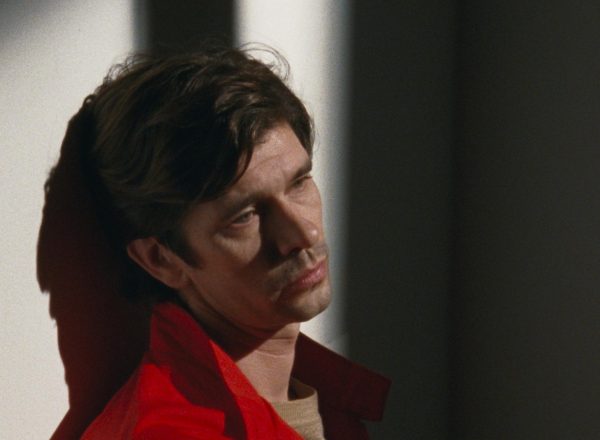
Hammel: Hujar — and this is all from the text and from the transcript — but he is so insecure about his own work and he’s always nervous about how the photo’s going to turn out and he’s doubting. Was that something that you were feeling during the making of the film and did you feel a kinship with Peter’s own neuroses across decades?
Sachs: That is, most profoundly, the thing I take from the film. For me, most personally, now that it’s completed, I have very few examples where an artist has been as transparent about the amount of doubt they experience in the making of something they believe in as this particular text provides. I find it very comforting because I’m consumed with doubt in the process of making anything. I think we don’t think that our — you know — you’re kind of like, “Peter Hujar, you doubted?” It’s a surprise because we see things as completed objects. And I think this film and this text reveals the personal seams and the personal vulnerability at stake when people make things. That’s, to me, the most terrifying and beautiful part of making a work of art.
Hammel: It doesn’t feel like [there’s] a specter — there’s no kind of ghostliness hanging over the movie — but there is that kind of essence of: something’s lost here. Peter’s dead, but also the 70s and that community of artists in the [East] Village, as a contemporary audience member you feel that loss of — they’re in a moment that we’re just getting a glimpse into that’s going to pass us by again.
Sachs: Yeah, well, it’s a film about the ephemeral, right? I think also what hangs over the film is AIDS and Peter’s death from AIDS and the death of so many in that community. I made a film in 2010 called “Last Address,” which is an eight-minute poetic elegy to a group of New York City artists who died of AIDS. In a way, this film is the completion of that work, because that film is anti-biographical. You learn nothing about the artists and this film is, in a way, the absolute inverse. You don’t learn — you just learned about a certain day. So in a way, I could make a film like this about all the artists who I honored in that movie. I don’t know. I think I’m just still trying to kind of create some sort of companionship with this group of New York City artists as I am also one myself.
Hammel: Rebecca Hall’s such an attentive listener and such an embodied performer. She barely really has actual lines in the film, but it’s just as much of a two-hander as any other two-man play or two-man film. What was the direction you gave her, because it is Peter Hujar’s day, it’s his story, but she is the other half of the film. Were you hyper-cognizant of how Linda’s part in the film was going to play out?
Sachs: I think I just tried with the camera to pay attention equally to them both, because I thought both of them were significant in every moment. To listen is to be present and to attend, and it’s an active role. So I think that was significant and Rebecca brought a — she really understood that the job was to be curious with empathy and to do that, and also without pride. I love, for example, many times in the film, Linda says something funny or some aside and Peter doesn’t pay any attention, which always makes me laugh. I love that Rebecca never lets Linda be hurt by that. She’s very confident somehow in her role. I think I did, towards the end of the film, understand that there was a kind of emotion that was coming forward on the set that I wanted to encourage, because there was something about that last scene, which we can talk about what you spoke about, which is very theatrical. When Ben is in the chair describing the end of his night… the performance becomes something quite different. I was thinking of Elizabeth Taylor at the end of a movie called “Suddenly, Last Summer,” where she tells the story of what happened suddenly last summer in a way that is, to me, one of the most beautiful scenes in American cinema. Because it is both real and unreal and the unreal quality is really tantamount to its power. I wanted to give space to the theatrical throughout the film.
Hammel: With Ben, you kind of share an affinity for queer art and for queer sensibilities. You founded Queer Art, the nonprofit; what is it about this film and kind of looking back to this generation of that intimacy of the Village that struck you and do you think there’s a, not a clone of that today, but do you see any sort of similarities with any movements or particular scenes today?
Sachs: Well, I think specifically because of a lack of economic security for artists making queer work, it’s important to find other definitions of value collectively and communally. And so I try to do that when I sell my projects. You know, this project, the only thing, I couldn’t promise that it would even be a feature, so I didn’t say to the investors that they would make any money on the film, but somehow they trusted that we would make something of value. I think to continually question what is of value is really important. And that’s something, I think, because so little of Peter’s work was valuable at the time of his death. And yet it’s so valuable now culturally. I think to respect that, the difference between creativity and capitalism is really key.