

Paul Thomas Anderson’s 10th film, “One Battle After Another,” opens on a revolutionary organization, the French 75, raiding an immigration detention center to lock up its guards and free its prisoners. Teyana Taylor’s headstrong, enigmatic revolutionary holds Sean Penn’s steroidally dried out white supremacist Col. Steven J. Lockjaw at gunpoint and declares, “My name is Perfidia Beverly Hills and this is a declaration of war.” Then it’s off to the races.
Anderson is no stranger to the sweeping epic. From his second feature, “Boogie Nights,” to his latest, “Licorice Pizza,” each of his films has encompassed a massive scope and unfurled itself onto a befitting canvas. Preoccupied with brash and flashy style for his first four features, Anderson declared himself as one of the towering cinematic voices of his generation with his loud pop portraits of America with expensive needle drops and ensembles to rival his idol, Robert Altman.
With his 2007 historical epic, “There Will Be Blood,” Anderson announced a new, more refined era of his career and was cemented as one of his generation’s preeminent voices by critics, audiences and The Academy, which awarded that film two Oscars. In his following four films, Anderson expanded his purview of American history, taking on different eras of the nation’s development and becoming a sort of foremost recounter of the great experiment, save for the wonderfully singular and European “Phantom Thread.”
After five consecutive films and 23 years looking to the past for his art, Anderson has finally come barreling into the present day full steam ahead, engulfed in a cloud of fire and ash with “One Battle After Another,” a blistering tale of the America of today in all its countless evils, mirthless humors, inane violences, bleak realities and hopeful futures. Taking Thomas Pynchon’s “Vineland” as an inspiration, Anderson dauntlessly maps out the psyche of modern-day America onto that 40-odd-year-old text. Prescient when Anderson wrote it, timely as it releases, “One Battle After Another” is the definitive movie of 2025, for better or worse.
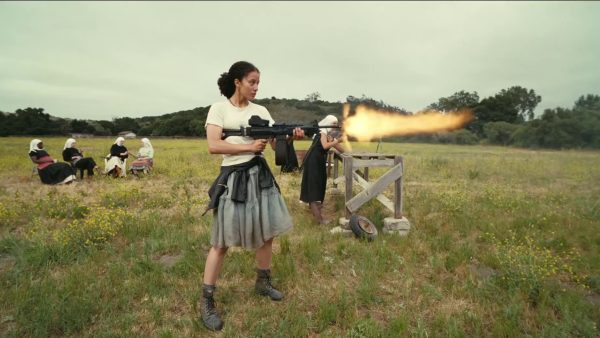
After the opening immigration detention raid, Lockjaw pursues the French 75 as Perfidia falls for and has a baby with another revolutionary by the name of Ghetto Pat (Leonardo DiCaprio) before Lockjaw gets too close to home and sends him into hiding with their daughter as they change identities. Sixteen years later, the duo has become Bob and Willa Ferguson (Chase Infiniti), and they are once again on the run alongside fellow revolutionary DeAndre (Regina Hall) as Lockjaw hunts them down to tie off any loose ends in a purity test for access into a white supremacist group known as the Christmas Adventurers Club.
Subtlety is not on anyone’s mind here. This movie makes no qualms about being a battle cry against the racialized violence and injustice of the America around it. Its villains are flat-out white supremacists, its heroes are mostly Black revolutionaries. Rarely does Anderson make anything in his films so cut and dry. For him to paint in such literal black and white from the start provides a stark contrast to the rest of his filmography as he beckons those he finds sensible toward the remaining adventure through this madcap world and immediately turns away those who are not.
After a bravura opening half-hour or so that functions as one non-stop montage, the film picks up with a teenage Willa and a burnout Bob. Infiniti is a star in the making, assured and vulnerable as a girl raised by a revolutionary, Bob, whose priorities shifted to fatherhood and, somewhere along the way, to the path of least resistance. DiCaprio is hysterical as a The Dude-esque crashout, futzing with his flannel robe and spliff-stained beanie, whose bumbling oaf routine, often exhausting in other films, is a treat here when met with Anderson’s frenetic and whip-smart satirical bite.
Anderson’s primary mode, as puppet master comedian at large, is never not in play here; he just intentionally backseats it to the gargantuan scope of the project. Anderson switches his funny bone into formality as he locks into this scope, grander than what he has aimed for in years, crafting this sprawling action saga with the confidence of someone who’s pulled off ten of these. Laughs often come situationally, coaxed from his wonderful cast, particularly a scene-stealing Benicio del Toro as a zenned-out sensei-cum-Latino Harriet Tubman, while Anderson leans elsewhere into the earnestness of a father looking at the landscape and trying to hunker down for the storm.
Maturity reigned from 2007 on for the auteur, fatherhood being the prime culprit for this change. The elegant craft of his films and sophisticated polish to his scripts feel derived from a shift in perspective that rears its head with a new face here. The gonzo spectacle of “One Battle After Another” is as large-scale and bold as any proper franchise blockbuster, though this puts most to shame with its craft and ingenuity in vision, yet the beating hearts at the center remain pure and earnest to a surprising degree. Anderson, never one to shy away from vulnerability, as in the very revealing last two films, here worries for the future, the one his children will come to inhabit.
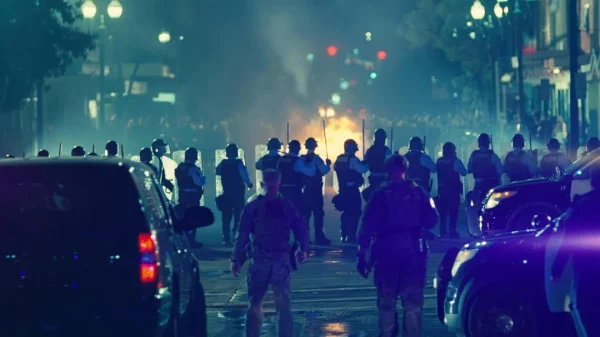
The hermitty and curmudgeonly ways of Bob Ferguson feel representative of a fear of the present day. His Luddite tendencies, urging Willa never to have a phone and to practice their well-worn safety tactics, are eventually proven justified, but his fears and conservative selfishness aren’t. His journey is one of rediscovery of the cause, of what it was that he fought for all those years. The revolution wasn’t just a youthful fire lit by the urgency of one’s prime and dimmed by the reality of your child’s safety; the revolution was in service of that child’s very safety, of her future. Anderson displays that he wasn’t afraid of depicting the current moment; simply, he knew the moment all too well and waited to drop his pinpoint-accurate reading of it like a bomb onto the canvas of an ever-fractured and endangered America of 2025.
“One Battle After Another” takes aim and hits bullseyes, but its emotional center is far richer than any movie “that we need right now.” Anderson has delivered a knockout centerpiece, of the year and maybe of his career, that posits a present worth fighting for and a future that must be protected because time never stops marching on. Generational gaps and radical political divides draw lines through and between characters, expertly drawn and brought to life, but it’s Bob, whose meandering journey up and down as the ensemble around him barrels forward, who finds that those generational gaps can be closed by realizing the future comes for us all and that it’s better to fight for the right side, the winning side. Anderson’s home run is a definitive film of its decade, for better or worse. What’s the right side?
“One Battle After Another” opens Sept. 26.