
Scream queen Samara Weaving reprises the role of Grace in “Ready Or Not 2: Here I Come” as one of the most iconic horror archetypes.
Coming to theatres in late March, the horror-satire is set within a secretive gathering of the ultra-rich, broadening its focus away from one bloodline to suggest a larger network of inherited power that will preserve their status at any cost. Grace’s ties to her fiancé’s wealthy family, the Le Domas, continue to haunt her and her estranged sister Faith, played by Kathryn Newton.
Early on, the film uses satanic allegories and dark humor as modes to critique generational wealth and elitism, but its execution of these themes leaves something to be desired.
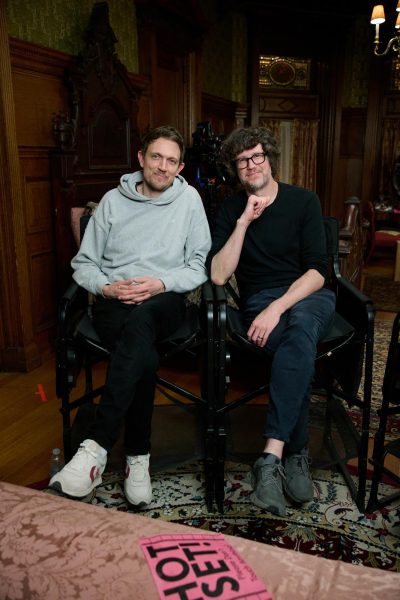
“Ready of Not 2: Here I Come” is made by Radio Silence for Searchlight Pictures, the film collective of directors Matt Bettinelli-Olpin and Tyler Gillett formed in 2011. Bettinelli-Olpin grew up in Oakland, eventually going on to attend University of California, Santa Cruz. Bettinelli-Olpin has always had a passion for the Bay Area arts scene, playing guitar in the local band Link 80 during the late 90s. The punk-turned-director credits his early involvement in alternative scenes for creative inspiration in his ongoing film career.
“More than anything that I’ve taken from growing up there is try to be original,” Bettinelli-Olpin said in a roundtable interview with college journalists. “Try to be unique, don’t try to imitate, try to do your own thing, figure it out.”
Radio Silence had their start in the indie analog horror film scene with their first release “V/H/S” in 2012, with a budget of $200,000 and gross of $1.9 million globally. Comparatively, the first “Ready or Not” had a budget of $6 million.
Since Bettinelli-Olpin and Gillet’s humble beginnings, the directors’ trajectory has veered away from arthouse film into horror franchise stewardship as signified by their work in “Scream,” “Scream VI”,“Scream 7” and now with “Ready or Not.”
From their experience working in the big leagues of horror, Radio Silence’s sensibility is now more driven towards mass appeal and generating new audiences for a large corporation. Their filmmaking investigates power while still operating inside of it.
Much like how the director duo seems to operate under the increasing power struggles in the film industry, the Le Domas family’s fortune is revealed to be from a pact with the demon, Mr. Le Bail, played by James Vanderbilt. In a scene from the first film, Grace sits exhausted on the steps of the burning Le Domas mansion with a cigarette while a vibrantly smoldering composure echoes the ending scene of the 1988 film “Heathers.”
The original “Ready or Not” saw positive reviews in its August 2019 release. Weaving’s performance as Grace perfectly portrayed a blend of horror and comedy and the film’s mix of gore and dark comedy is exactly the kind of thrill horror fans live for.
Grace’s bold and defiant character is contrasted by her sister Faith who is initially more composed, becoming increasingly more fearless as the movie progresses. Faith grew up in foster care alongside Grace, but the two had a falling out after Grace moved to New York when she turned 18. Where the first film’s theme was marriage, this film explores sisterhood as the two are forced to work together to dodge death, one chase at a time.
The sequel sharpened the first film’s satirical value by expanding on worldbuilding, clarifying that the Le Domas Family are not an anomaly, but rather a small component of a global ritualistic cult who represent elitist powers around the world. Grace and Faith are hunted by the members of this cult after Grace’s escape from death at the hands of her fiancé’s family.
What is arguably most frightening about “Ready or Not 2” is how plausible it all feels in comparison to modern settings. The idea of elites being above repercussions no longer registers as entirely fiction.
In regards to recent governmental exposition surrounding the Epstein Files, the movie frames wealth as predatory. Across the globe, citizens are questioning the secret activities of the wealthy behind closed doors. The film unapologetically taps into these speculations, giving audiences a depiction of that world without ever fully confirming or denying it.
In doing this, the sequel feels non-committal in its narrative. The film’s villains are frustratingly ambiguous; with motives feeling inconclusive and lacking depth, characters ultimately feel more like cartoonish figure-heads for the rich rather than accurate depictions of the wealthy. The story may feel like a class critique, but it doesn’t deliver a definitive thesis. Besides small quips, there is little commentary that allows for a definitive critique of economic or class systems.
The film’s focus is entertainment first, visuals second and social commentary last. One can’t help but wonder if the message of this film would be better without diluted one-liners and took time to let the horror of the film linger to emphasize its message instead of privileging marketable shock over political confrontation.
The film stands as Radio Silence’s first sequel to a film of their own creation. Bettineli-Olpin and Gillet mostly stuck to the integral parts of the first film in their usage of practical effects over special effects, prioritizing character driven horror to build tension instead of sharp political depth. Their love and loyalty to satirical horror is shown in the way “Ready Or Not 2”’s tone is defined by the blend of dark humor in a merciless setting.
“Ready Or Not 2” is more culturally charged than its forerunner. The film does well using horror to mirror current realities enough to capture audiences, but only gestures systemic indictment. In reality, the narrative sees corruption as individual failure by only criticizing the wealthy as if they are controlled by a literal pact with the devil.
In the end, the villains feel like victims of a cursed bloodline rather than people with inherited advantages gained through structural violence and exploitation.
“Ready or Not 2: Here I Come” opens in theaters March 20.