

For over a decade, video games have been chasing the dream of a Hollywood-quality story that is truly interactable and influenced by player choices. Studios have lived and died trying to fulfill that promise. With “Dispatch,” we see real success.
Episodic adventure games are nothing new. Telltale Games hung its hat on the format until its closure (and revival) in 2018, really only achieving success with the first season of “The Walking Dead” in 2012. Other studios like Don’t Nod followed the trend to create series such as “Life is Strange,” and the two-parter “Lost Records: Bloom & Rage.” However, the format often encountered developmental struggles which led to inconsistent release schedules or rushing out games with major performance issues.
After the initial shutdown of Telltale Games, several veteran developers from the studio banded together to create something new, AdHoc Studio. This fall, they made their debut with “Dispatch,” a workplace comedy where superheroes band together to protect the citizens of Los Angeles. The game is made up of eight episodes, released two at a time over four weeks, and features a choose-your-own-adventure style of storytelling. After the final two episodes dropped, AdHoc reported 2 million players, a remarkable number for the studio that was saved by partners Critical Role in the middle of production.
Enough can’t be said about the extraordinary cast of the game. “Dispatch” is led by Aaron Paul, who gives a stellar performance as the player character Robert Robertson, also known as Mecha Man. Those familiar with Paul’s previous work know just how well he can deliver a sympathetic performance and he does not miss with his role as a superhero who hits rock bottom.
Alongside Paul, AdHoc tapped Jeffrey Wright to play the foul-mouthed speedster Chase, who is a mentor to Robertson. Wright is no stranger to video games, appearing in 2020’s “The Last of Us Part II,” and his performance as Chase withholds his reputation as one of the most dynamic actors of the past decade.
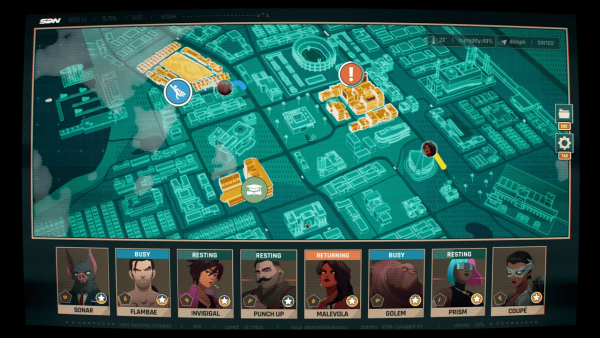
Robertson tries to pull himself up from his lowest point in life as he takes the role as the dispatcher for the Z Team, a ragtag group of former villains who hope to change their direction in life by joining the Superhero Dispatch Network. Friction amongst the characters is unavoidable and hilarious. Players navigate Robertson’s relationships with his new coworkers through dialogue branches which carry consequences throughout the season and can also take over as Robertson sends out the Z Team on missions and odd jobs throughout Los Angeles, choosing which hero to send where based on their particular skills and teamwork.
The gameplay, while quite fun, takes a backseat to the stellar story. The writers and actors nailed the dry, almost improv-like, comedy that is woven between the heavier themes of the game. None of the characters in this game are perfect, even the god-like Phenomaman, and each interaction between them reveals more of their reason for being on a team that is about giving second chances. Robertson is constantly reminded that he is not Mecha Man anymore and faces having to enter the next phase of his life while training a new class of heroes. Through dialogue choices, the player guides Robertson’s escape from depression by building relationships with his new team.
The Z Team quickly becomes the heart of the story, not only because of their dreams of making their second chance worth the risk SDN takes, but because they are brought to life so earnestly by the YouTube celebrities who play them.
MoistCr1TiKaL, Jacksepticeye, Fahim Anwar, Thot Squad, Mayanna Berrin, Alanah Pearce and Yung Gravy all absolutely nail their respective characters on the Z Team and consistently hold their own acting opposite Paul. Casting internet celebrities often feels like a pandering play to attach popular names to a project in hopes that Gen Z and younger audiences consume the project in droves, but it actually feels inspired in “Dispatch.” By the end of it, the crew behind the Z Team gave some of the best performances I have seen in video games all year.
On paper, this game was doomed to be mediocre at best with a format that hasn’t seen success in over a decade: trying to use Hollywood stardom to elevate a video game and veteran developers creating a new studio and punching above their weight class right off the bat. It’s been seen over and over, but rarely is it met with success.
Opening this game by putting the main character at his lowest and proceeding to pull him up episode after episode is the perfect analog for the task the AdHoc founders had at hand. Yet, as we see in the story of “Dispatch” itself, trusting in the heart of the team and never giving up on the vision pays off.