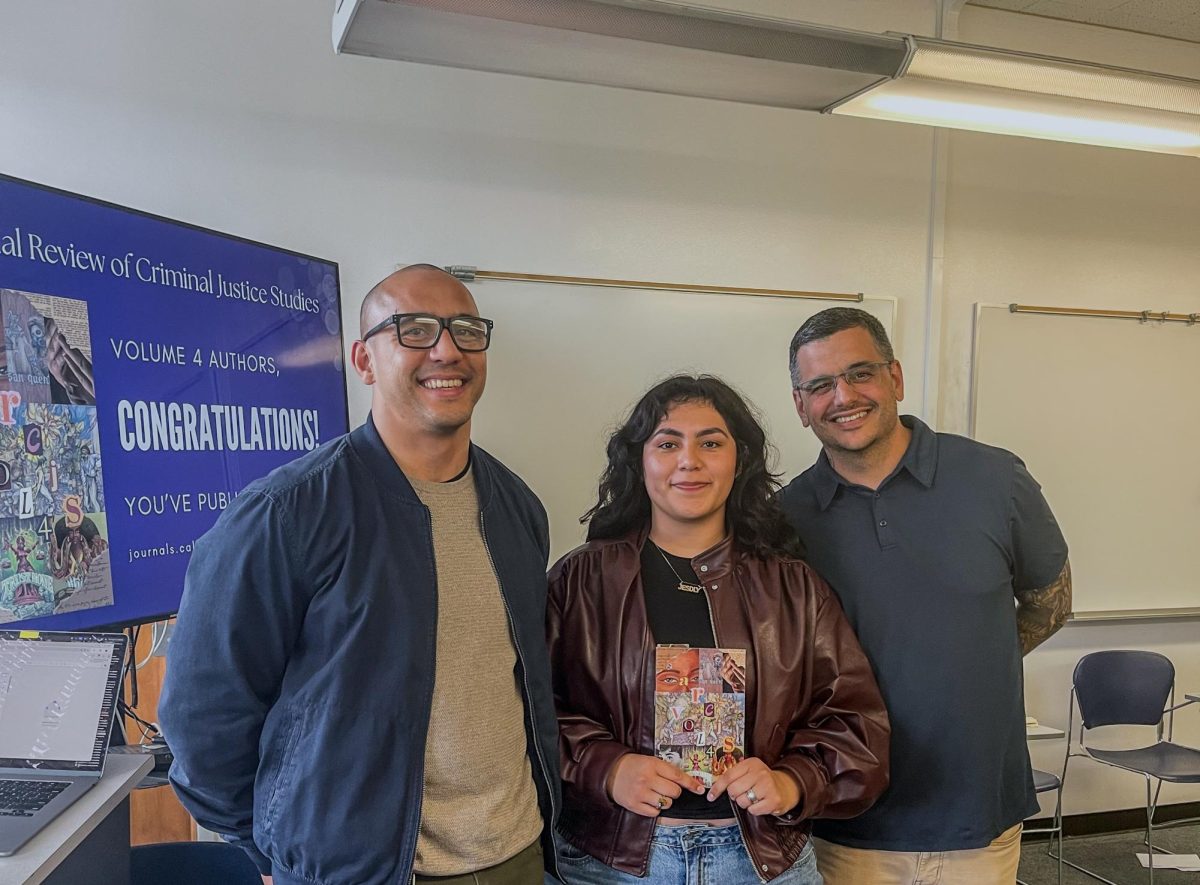
Criminal justice students at San Francisco State University gathered yesterday to celebrate the fourth issue of the Annual Review of Criminal Justice Studies, a student-led journal that has been published yearly since 2023.
Students assembled in HSS 358 to collect a print edition of the publication and network with other peers and faculty members. The student-led, peer-reviewed anthology of research papers, poems and art works amplifies student voices and perspectives on criminal justice. For students passionate about social advocacy, the publication is a way to analyze the U.S. criminal legal system while bringing awareness to systemic injustices.
Albert de la Tierra, an assistant professor of criminal justice studies at SFSU, highlighted the publication’s intentions.

“It creates a space, an intellectual culture and community for some of our brightest undergraduates here,” de la Tierra said. “Although the journal is housed in the department of criminal justice studies, it’s interdisciplinary and we want and invite students from across campus.”
All students can publish in the ARCJS, leading to possible advancement later on in their education.
“It gives folks some symbolic capital to be able to apply to grad school, apply to jobs and internships,” de la Tierra said. “If we look at the previous authors in our volumes, folks have gotten into master’s programs, Ph.D programs… straight into the field.”
Gabriel Singer, an international relations graduate, served as editor-in-chief for this year’s edition. Singer, alongside Jayden Richiez, reviewed 21 student works for the final print in a year-long selection process.
“It really centers around the student’s voice and what they see within society with a criminal justice lens,” Singer said.
Students have written about mental health issues within law enforcement, and how some cultural experiences are not adequately represented within the criminal justice system.
“Once they get an idea or they have a hypothesis, they can go research that, write about it and then bring it to the table,” Singer said. “That elevates education, research and voices about very serious and sometimes abusive topics of criminal justice.”
Vi Lee, a third-year political science and Asian American studies major with a minor in criminal justice, expressed the benefits of their paper being published in this year’s edition.
“It just is a really great opportunity to be published as an undergrad,” Lee said. Their piece, “Asian Prisoner Revolution,” aims to bring awareness to the Asian American demographic in the U.S. prison systems.
“I was writing about the kinds of experiences of Asian American prisoners, but then also the things that led them to being incarcerated,” Lee said. “We know so much about the overplacing and the profiling of Black and Brown communities, and I haven’t seen or heard that much discourse on Asian American communities.”

Fiona Engstad, a fourth-year psychology, criminal justice and political science major, was also featured in the publication with her piece “Diagnosis and Criminalization of African Americans with Serious Mental Illness: Deconstructing Solutions.”
“It took a long, long time. My final paper was 30 pages,” Engstad said. “It started out from an essay that was assigned in class, and then it turned into this.”
Engstad will be next year’s editor-in-chief of ARCJS. Her passion for her paper ignited after being offered a job at the San Mateo Acute Stabilization Unit.
“My piece is about African American men who are diagnosed with schizophrenia, who are diagnosed at a rate three to four times higher than any other population, despite being underdiagnosed for every other mental illness,” Engstad said.
86% of arrests were for people with schizophrenia or schizoaffective disorder, according to Engstad. Engstad also said that 30% of the arrested people were African American despite the county’s population being only 2% African American.
“I just snapped,” Engstad said. “I thought, I have to bring awareness to this.”
Engstad is grateful to be involved with ARCJS.
“I am so grateful to be a part of a journal published at San Francisco State,” Engstad said. “We have such a rich history of social justice, protests, and resistance. And I’m so grateful to be able to publish in a journal that stands for humanity.”