

Nearly 70 years after its debut, it’s fair to say that “My Fair Lady” has stood the test of time. Most recently revived in a 2022 West End run, Alan Jay Lerner and Frederick Loewe’s musical has changed and adapted over the decades to delight new generations with the classic tale of phonetics, love and the rain in Spain.
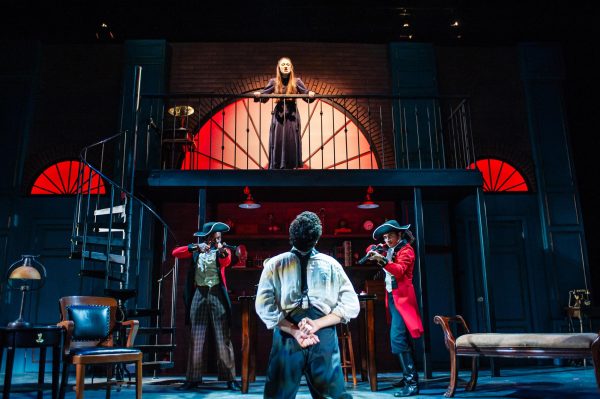
Right now, San Francisco Playhouse has staged a delightful production that keeps the magic and splendor of the original text intact while embellishing the decades-old material with hefty doses of welcome humor and playful subtext.
The story revolves around Eliza Doolittle, a poor flower girl with a thick Cockney accent who takes the interest of Professor Henry Higgins, a renowned phonetician, as he sees her speech as a challenge for him to help her overcome. When he takes her under his wing, Doolittle’s father gets wind of it, and the linguistic hijinks ensue.
When handling material as beloved as “My Fair Lady,” one must consider its storied past. From its original Tony-winning run to its Best Picture-winning adaptation, the musical has already left more than a mark in the pantheon of Broadway. Many of Lerner and Loewe’s numbers have become standards over the years, and Cecil Beaton’s original costume designs for Eliza are beyond iconic, especially the black and white ascot dress so often associated with Audrey Hepburn’s turn.
It comes as a welcome surprise that San Francisco Playhouse’s production of the show has found a new angle. Bill English’s direction adds dimensions of levity and tension to the show and between characters that expand the original text in truly exciting fashion.
Doolittle and Higgins’s will-they-won’t-they is the fuel to the show’s fire in every staging, but Jillian A. Smith and Adam Magill wrap themselves completely around these roles, and their chemistry proves heated and razor-sharp. Smith’s heart-on-sleeve earnestness endears the audience to Doolittle immediately, and her rendition of “All I Want” is a knockout that skillfully sets the show’s hopeful and playful tone. Magill’s take on Higgins is more wily and erratic than one would expect, and the production is all the better for it. His jaded and studied persona juts up against Smith’s bluster perfectly.
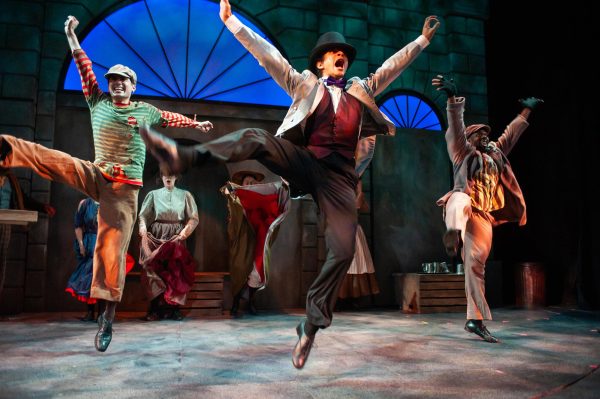
The supporting cast is similarly exceptional and provides a bouncy ensemble without a bum note in sight. Every number is performed with gusto, and raucous applause feels like the only natural response. While this proves a delight for the audience, it’s also a blessing for the small stage as the players really fill out a tight space to its fullest potential. The sets are equally resourceful as Nina Ball’s scenic design transforms an open street corner into Higgins’s office into a derby stand.
This expansion of the stage meets a rather welcome expansion of the text. In staging the show, English has peppered in a playful homoeroticism between Higgins and his confidante and fellow phonetician Colonel Pickering, which makes the phonetic triangle between the duo and Doolittle all the more enticing and jaunty. The lessons in and practice of repartee in later scenes bear a quiet dance that enlivens a show with plenty of charm to spare already.
With a bona fide classic like “My Fair Lady,” it’s easy for revivals to mark it and play the hits. At San Francisco Playhouse, the show has gained a new life and feels as fresh and bold as ever. The show wears its years well, and this cast and crew have breathed new life into Lerner and Loewe’s timeless affair.