

There comes a point during “Eleanor the Great,” a film that presents itself as an inoffensive festival crowdpleaser with enough charm to carry its 90-odd minute runtime, where everything goes topsy-turvy. Beyond this point of no return, one assumes a daring and unpredictable story lies ahead. How disappointing, then, that such an unexpected decision still yields a middling matinee charmer with far too little glue to hold far too many threads together.
After starring in this summer’s “Jurassic World Rebirth” and topping Hollywood’s chart of profitability, Scarlett Johansson has stepped behind the camera with her first feature as a director. For such a leviathan movie star’s directorial debut, “Eleanor the Great” is an admirably small effort. There’s a lack of ego in taking on a project so intimately staged that nearly belies its quality.

“Eleanor the Great” follows Eleanor Morgenstein (June Squibb), a 94-year-old Jewish woman who moves back to New York after her best friend of 70 years, Bessie (Rita Zohar), dies. Moving in with her daughter Lisa (Jessica Hecht) and grandson Max (Will Price), Eleanor accidentally finds herself in a Holocaust survivors meeting and, despite having grown up in the Midwest, tells Bessie’s story of living through it as if it were her own. Nineteen-year-old journalist Nina (Erin Kellyman) quickly befriends Eleanor and takes to her story, which her renowned journalist father Roger (Chiwetel Ejiofor), takes interest in.
If that sounds like a lot to throw at an audience, it is. At the film’s pivotal moment, it’s as if Tory Kamen, the screenwriter, took the bones of “Dear Evan Hansen” and substituted a friendship for the Holocaust. That idea could be the genesis for a heightened comedy or severe drama, but the film opts for the preferred mode of operation for most American indies: riding the line between both, rendering neither satisfying.
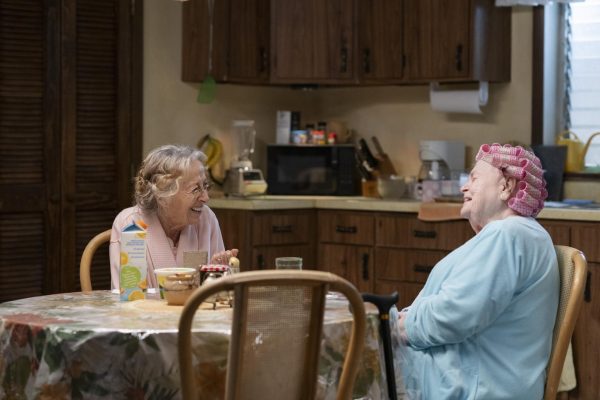
In the middle of this tonal dissonance, Squibb stands tall and radiant. Squibb, who is 95 herself, lends a vivacious spirit to Eleanor and her no-nonsense way of life. Her early scenes with Zohar are quite lovely, if rote, and her flinty but warm demeanor with Kellyman is charming in spades. Much like her turn in last year’s “Thelma,” Squibb elevates the material singlehandedly. Taking on her first two leading roles in her career in her 90s, Squibb’s run as a nonagenarian indie darling is something to behold.
Squibb’s surrounding ensemble is quite effective, but with every scene handled all too safely by Johansson, the cast can’t break out of their bubble. Hecht, perennially underrated, gets relegated to a minor role of the nagging type-A daughter, but gets a standout scene with Squibb that gestures at a thornier film which never materializes. The mother and daughter discuss aging and what they wanted and never got out of life in the movie’s crowning scene, yet it’s not treated as such. Instead, the film plods out typical cozy dramedy beats.
“Eleanor the Great” is satisfied, for its gratefully brief runtime, to run the course of the big lie, the befriendings, lessons learned, misunderstandings and revelations. All goes practically to plan and none of these beats reveal a deeper insight into any character despite the cast’s noblest efforts.
Johansson cast real-life Holocaust survivors to portray the members of the group in the film, signifying a real sensitivity and care for the subject, which unfortunately doesn’t lead to a greater curiosity in it beyond some affecting, if heavy-handed, flashbacks with Zohar. The imbalancing of such a horrific experience with light-touch situational comedy makes for a true odd couple of tones that the film never gets a hold of.
Much of “Eleanor the Great” is quite charming, and Squibb never fails to delight, but the film’s daring premise can never find a footing to outshine the shortcomings in the big picture. Johansson’s pedestrian direction is never an issue, but it does beg the question of why such a star would attack something so seemingly personal from such a distance.
“Eleanor the Great” opens Sept. 26.