

Frustrated voices turned into a chorus of hope as students and faculty gathered in Room 304 of the Humanities Building on Monday and Tuesday for a two-day town hall hosted by the San Francisco State University Student Union.
Discussions focused on issues including the political science department’s shrinking budget, canceled classes and the loss of lecturer faculty. Students and faculty raised the concern that only one class section of Comparative Politics and Introduction to Political Theory, both required for political science students, are being offered next semester.
“It’s kind of insane that there’s only one section,” said Gwen Hunter, a third-year political science student in attendance. “Every single political science major and minor for undergrad needs to take these classes.”
Faculty members said the department no longer has any lecturer faculty, meaning full-time professors must shoulder heavier workloads.
“They would love us to exceed 18 units,” said Rebecca Eissler, an associate professor of the political science department. “But we’re not required to exceed 18 units, and we’re required to meet 18 units. Because we do four-unit classes, it makes the math a little bit odder than other departments.”
Students said that raising course caps, with some classes reaching 50 seats, puts student schedules and learning trajectories at risk. Course caps determine the maximum number of students allowed to enroll in a class section. Having a high course cap also means enrollment must meet a higher minimum number of filled seats to stay on the schedule.
“So if not enough people initially enroll, the class will just be cut, which obviously is a problem,” said Vi Lee, the first meeting’s facilitator and political science student.
Many described the pressure of watching their department shrink while millions were being spent elsewhere. The CSU system spent nearly $17 million on an 18-month period for OpenAI’s ChatGPT Edu.
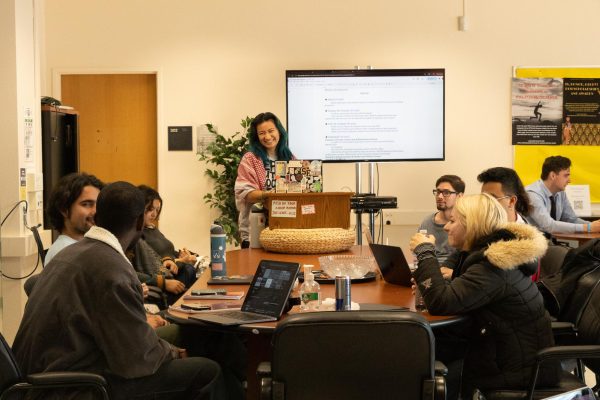
“While getting the university to take out the money isn’t something we can do right now, we can demand that no more money is put in,” Lee said.
Diego Huerta, a political science student and second town hall facilitator, shared his personal experiences with crowded classes and how the quality of his education was affected.
“My biggest concern is the fact that we don’t have any lecturer faculty,” Huerta said. “The raising of the caps is also concerning because it means professors are becoming overwhelmed with the amount of work that they have to sift through and the amount of people that they have to be responsible for.”
Huerta said the ripple effects reach everyone in the classroom.
“Growing up in California, as I progressed through my education, classes got increasingly large, and teachers in that case got increasingly anxious and stressed,” Huerta said. “That pressure translates into students. It’s less personal.”
The same hour that Monday’s meeting ended, an all-campus email from Provost Amy Sueyoshi landed in students’ inboxes, which didn’t sit well with many who had just attended the town hall.
“I know, though, that news of our enrollment decline and subsequent changes in the class schedule or in programs may have you concerned,” Sueyoshi said. “Fewer required units in a major does not mean diminished quality. It will allow you to take a variety of classes, maybe even study abroad, or develop additional competencies to make you more competitive in the job market. And, even more importantly, it might accelerate your time to degree — the very goal we all share for you.”
The message, written in a cheerful tone, did not sway the union’s perceptions. Several students quietly shared the message during Tuesday’s session, calling it ironic that the administration celebrated new programs and additions to SFSU, like three new undergraduate certificates in AI, while departments like political science struggled to keep introductory courses open.
“I think they could care less,” Huerta said. “You cut classes and professors, then you send an email that you want us to graduate faster? Makes no sense.”
Martinez said collaboration between students and faculty is key, stressing that everyone in the department must work together to find a viable solution for the betterment of the university.
“At the end of the day, there has to be a meeting in the middle,” Martinez said.
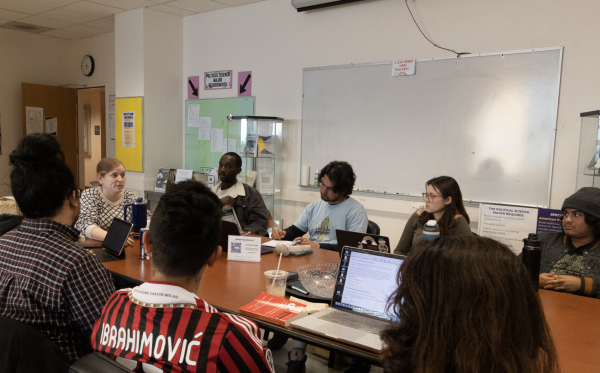
José Martinez, a political science student, said he came to the town hall not just to vent frustrations but to reconnect and rebuild. With an optimistic attitude, he expressed the need for town hall meetings like these.
“I think this is a step in the right direction,” Martinez said. “The high caps are going to affect teaching faculty and students. It’s about protecting the quality of education, not just getting more people into classes.”
The meetings also gave space for honest reflection. Methods to gain attention from the administration were discussed as students reflected on ways to build momentum and show that their movement extends beyond the classroom.
“I think it’s good to talk to professors about all these things,” Hunter said. “If they see we’re more unified, it shows this isn’t just 15 of us — it’s the whole department.”
Despite future uncertainties, the atmosphere in the room was warm and determined. Students discussed and brainstormed together for nearly an hour on both meeting days.
“If you come to meetings, you’ll be heard by everyone that’s here,” Huerta said. “Your input is valuable because your department depends on you and everybody else that’s willing to come to these meetings to be a part of some actionable change.”
The upcoming General Assembly on Nov. 13, co-hosted by the English and political science departments, will be the next step: a chance to finalize demands and vote on actions.