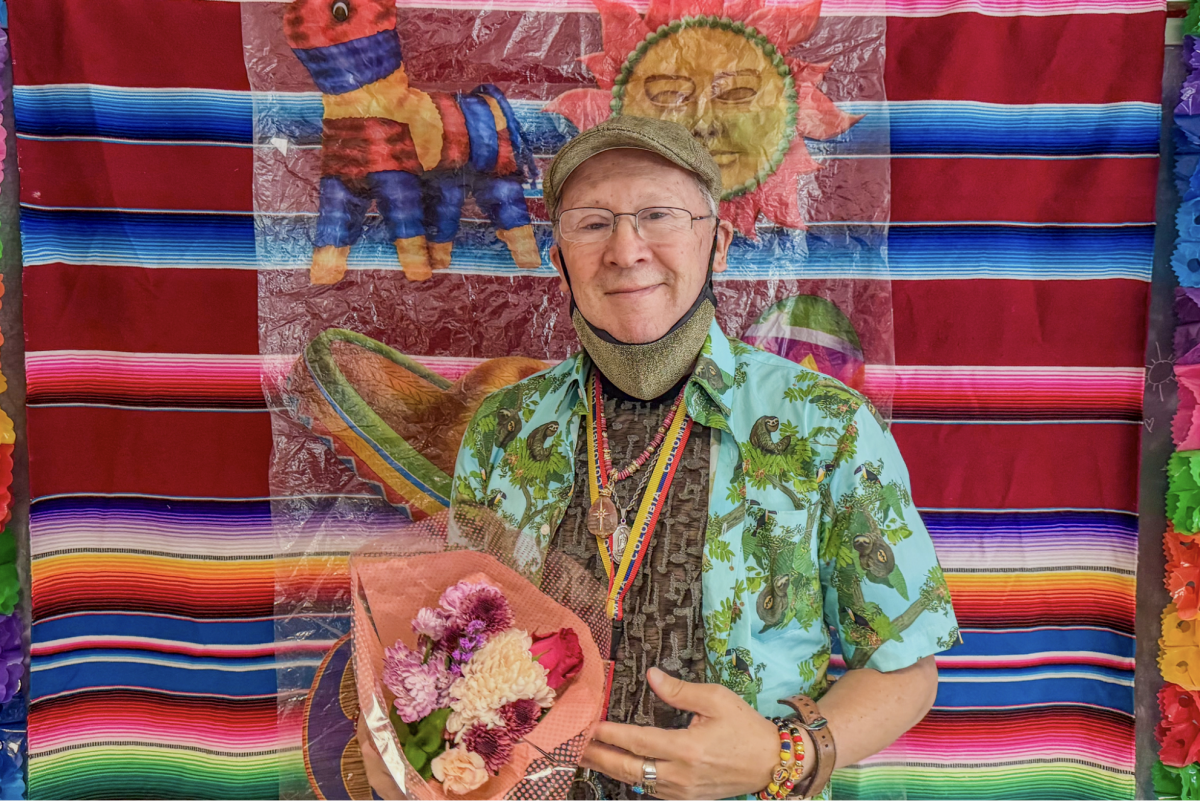
After 37 years of teaching, Spanish professor Gustavo Calderón said goodbye to San Francisco State University on Thursday with pride and gratitude.
Throughout his career, Calderón left a legacy that endures among generations of students and graduates who were once in his classes. Calderón’s path as a professor began as part of the “American dream,” where he arrived in the United States as a student with limited resources. He worked multiple jobs including cleaning houses, taking care of children and teaching Spanish while studying in Iowa.
“After the University of Iowa, I had a position at Drake University in Des Moines, the capital of Iowa, where I trained teachers in bilingual education,” Calderón said. “Then I got the position in New York. I stayed there for three and a half years and earned the United Nations scholarship, which opened many doors for me.”
Calderón’s arrival at SFSU was actually an accident. When working at the State University of New York, he sent applications to more than 50 universities, but didn’t expect to get a teaching position in San Francisco due to competition. A mistake by his partner ultimately led to his unexpected acceptance at SFSU.
“My partner, Marcos, made a mistake. He sent the Austin letter to San Francisco and the San Francisco letter to Austin,” Calderón said. “Imagine my surprise when they called me for a job interview. In life, you have to make deliberate decisions that sometimes happen because of a stroke of luck.”
Throughout his career, Calderon has participated in conferences and academic collaborations with institutions such as Stanford University, University of California, Berkeley and Drake University.
One of the most valuable aspects of his years in San Francisco has been the cultural diversity of both the city and SFSU, which he considers one of the most international universities in the world.

“This is one of the five most international universities in the world. For me, that has been a tremendously motivating factor,” said Calderón.
One of Calderón’s favorite memories teaching at SFSU was a map of the Americas with stars placed to represent his students’ countries of origin. He proudly shared that he eventually managed to represent nearly the entire American continent, from Canada to Argentina and the Caribbean.
“Every semester, in each class I teach, I place a little star on every country represented by my students. Imagine my joy when the map was finally complete,” said Calderón.
His passion for teaching also comes from his family.
“Today, I’m wearing my father’s cardigan, and he was an excellent professor. My mother was also a professor,” Calderón said. “We’re an academic family. We inherited that passion. Right now, there are 11 university professors in the family.”
Calderón’s retirement leaves the Spanish program without a specialist in Latin American studies and without its only Latino professor. The program will be left with only two professors and one lecturer.
“I’m the only Latin Americanist, and the new administration only keeps cutting programs,” Calderón said. “Right now, there are more administrators than professors. It’s very sad. They already told me that once I leave, the position will not be replaced.”
Calderón’s departure means that students’ academic plans are delayed with the reduction of courses.
Anderson Guzmán, a Spanish major with a minor in education, has been Calderón’s student since January 2025.
“It’s a real shame that he’s leaving. San Francisco State is cutting many programs,” Guzmán said. “I already saw online that next semester there are classes they’re not offering because he won’t be there.”
Guzmán said that he developed a close relationship with Calderón.
“He makes learning more enjoyable,” Guzmán said in Spanish. “To me, he’s like another father. He already knows about my son and my wife. He’s part of my family now.”
Alessandra Guevara, a Spanish major with a minor in education, spoke about Calderón’s impact on international and exchange students.
“He has that empathy to put himself in students’ shoes,” Guevara said in Spanish. “He’s very aware of the changes students go through and very understanding about it.”
Guevara said that the shortage of professors and available classes forced her to prioritize courses for her minor rather than Spanish courses for her major.
“There are four classes I couldn’t take because they’re not available,” Guevara said. “I had to focus on the minor so I could keep working toward my units because there are only two professors and the schedules are not good.”
Ana Luengo, coordinator of the Spanish program in SFSU’s Department of Modern Languages and Literatures, said that the department is trying to offer alternative courses so students can graduate on time.
“We are being more flexible while we stabilize again,” Luengo said in Spanish. “It’s a vicious cycle. If you lose students, you lose classes, and if you lose classes, you lose more students.”
Luengo expressed hope that the university will recover and eventually hire more professors to strengthen the Spanish program once again.
“I hope that soon we’ll be allowed to hire someone, but that’s not something being considered right now because the university has been cutting faculty positions as much as possible across nearly all departments,” said Luengo. “And it’s completely unfair. It’s unfair to you and to us.”
While the future of the program appears unstable due to the reduction of courses and professors, many of Calderón’s students and alum say his legacy will live on long after his final class.
“He is one of the memories of the ‘Golden Age’ when it comes to professors,” said Chloe Ballzer, who earned both her bachelor’s and master’s degrees in Spanish at SFSU. “He always created a family environment in every class and a truly valuable community. I still keep in touch with former classmates because of him.”