
You’re dead, make a decision. The logline of David Freyne’s “Eternity” is also the pitch of its many in-universe eternities. Sort of.
Freyne’s high-concept romantic comedy mostly takes place in a limbo waystation between life and only one of endless permanent eternities that you must choose to reside in. What happens if you die before your terminally ill spouse and decide to wait for her, only to find her first husband who died in combat has waited too, but for over 60 years? Whatever you just thought up as an answer is probably more interesting than Freyne’s.
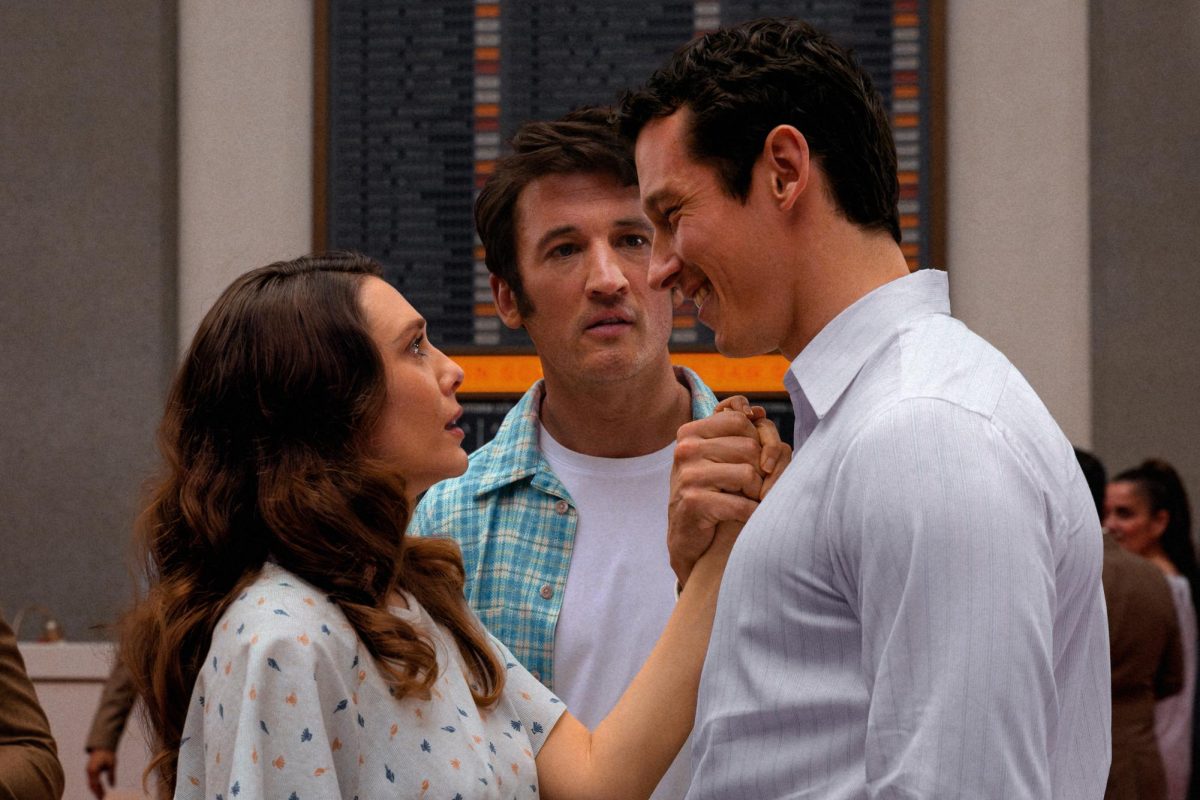
After Larry (Miles Teller) foolishly dies as an old man and arrives in this limbo, he can’t comprehend what’s going on until greeted by his Afterlife Coordinator Anna (Da’Vine Joy Randolph), who dryly goes through her usual routine as if informing him of an insurance policy. Reluctant to choose an eternity until his wife of 60-some years, Joan, arrives, he mostly waits until she passes on but Luke (Callum Turner), her first husband, and his A.C., Ryan (John Early), have other plans in mind. Hijinks ensue!
The tried and true push and pull at the center of “Eternity” begets immediate questions with boundless interesting branches to jump onto, but Freyne opts for the safe route time and time again. A love triangle is hard to biff, yet this one is played all too routinely by the utterly miscast trio, save for a deftly committed and entertaining Olsen who fits right into the 1930s screwball tone that the movie clearly needs and sporadically achieves, one which Teller and Turner are visibly embarrassed to lean into.
Cribbing from the many afterlife comedies of errors before it like “A Matter of Life and Death” and “Defending Your Life,” Freyne and Pat Cunnane’s script claims to walk a tightrope, a bit too proud of its concept despite following, not setting, precedent. Lack of originality shouldn’t be used as a knock against art, it’s all poetry, but when an old reliable concept is tackled with a safety net and training wheels rather than any new tools, it’s hard to see what turns the gears in the writers or why we should put the effort into turning ours. “Eternity” takes a down-the-middle, agnostic and administrative view of the afterlife, as the aforementioned predecessors (mostly) did, and unfortunately settles into a routine complacency with little charm from two-thirds of its leads to lean on.
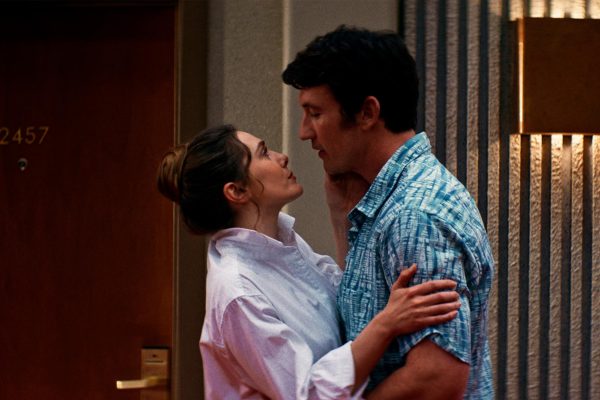
A pitch this ripe for screwball antics and emotional revelations only works in the right performers’ hands. Olsen, Early and Randolph light up the screen anytime they get the chance to shine and each brings their own specific comedic sensibility to their role. On the other hand, Teller and Turner are disastrous. Not only do they seem embarrassed to perform the heightened emotions that are asked of them, each actor is a charisma vacuum.
Larry is established, in a mildly charming prologue, as a nagging but charming and attentive husband whose milquetoast demeanor doesn’t negate his empathy. Once he, younger and looking like Miles Teller, wakes up to his afterlife, he becomes a far more annoying character, befuddled and klutzy in a manner that is surely charming on paper, but one which Teller cannot muster up. Luke is an unknown quantity, only seen in a dashing old photograph before he went off to war, and is ripe as a blank canvas for an actor to project decades of patience and loyalty onto, but Turner doesn’t bring much to it beyond an absurdly dashing visage.
What’s left on the table by the leading men is nobly swept up by Olsen, Early and Randolph as they seem overjoyed to play in such heightened sandboxes and with such fun situations. Joan’s impossible choice is rendered wonderfully, both comedically and dramatically, by Olsen in a perfect role for her, evoking old Hollywood stars as much as the natural charm of modern stars like Amy Adams while bringing her own earnestness and radiance to the role. Early’s comedic malleability is suited like a topsy-turvy glove to a position as absurd and delightful as his, while Randolph, fresh off an Oscar win, commands the screen and elicits the most hearty laughs and makes the most overwrought scenes sing, even playing against two wooden leading men.
While “Eternity” never dares to tread new territory or break new ground, it is still an easy watch. Freyne’s lack of ambition is always a bit deflating of his ideas, but he guides the story with a competent hand, even if it makes its narrative checkpoints abundantly clear before they arrive.
Most frustratingly, the movie arrives at a truly daring conclusion about 90 minutes into its runtime. Joan comes to a decision. It’s cathartic, fresh and justifies the hemming and hawing that preceded it. Yet, it would be too off-putting for a film as cozy as “Eternity.” So, the audience is resigned to accepting a more pat conclusion. Thankfully, the film doesn’t overstay its welcome and ends mercifully fast. In its limited view of what an eternity may look like, Freyne’s film, if anything, is a powerful tool in making you appreciate how boundless a medium like cinema can be in just how many artificial boundaries it sets for itself.
“Eternity” opens in theaters on Nov. 26.