



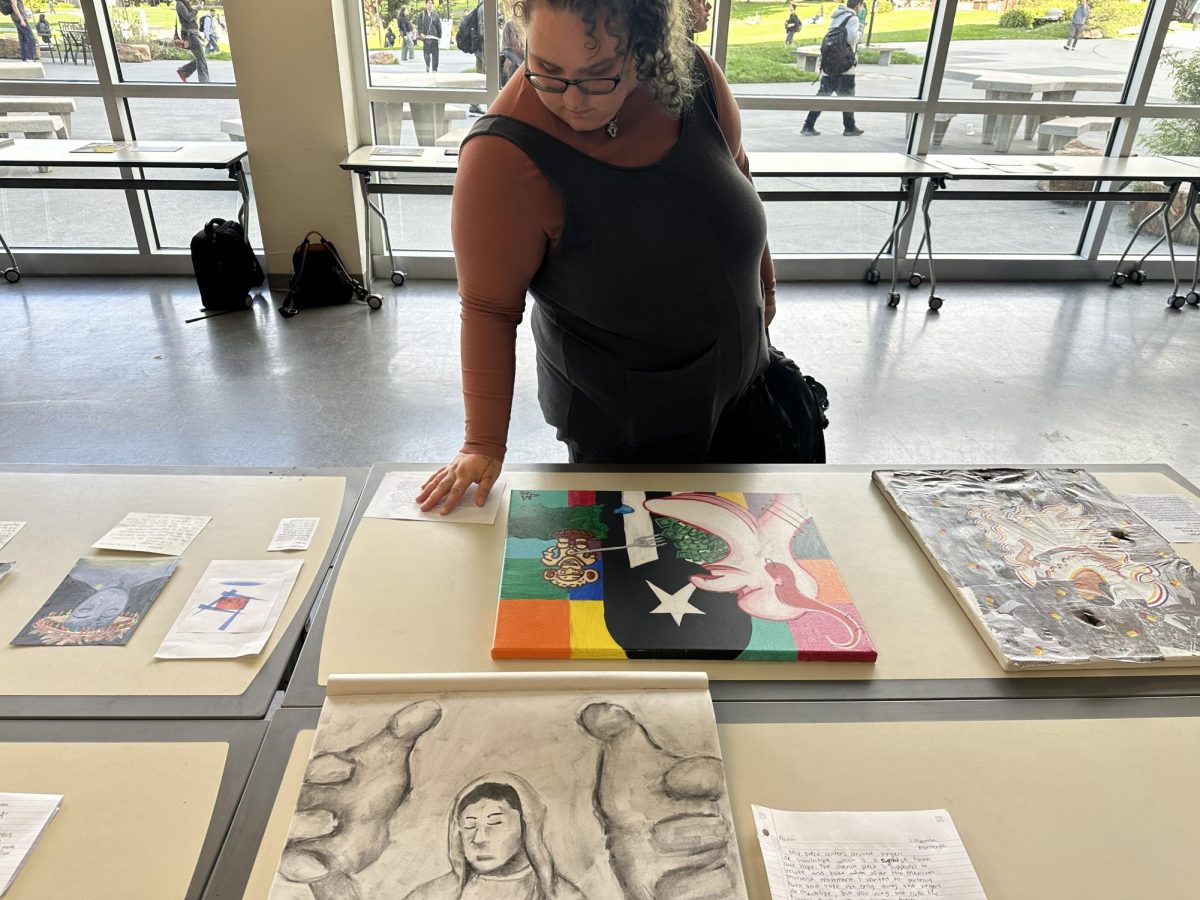
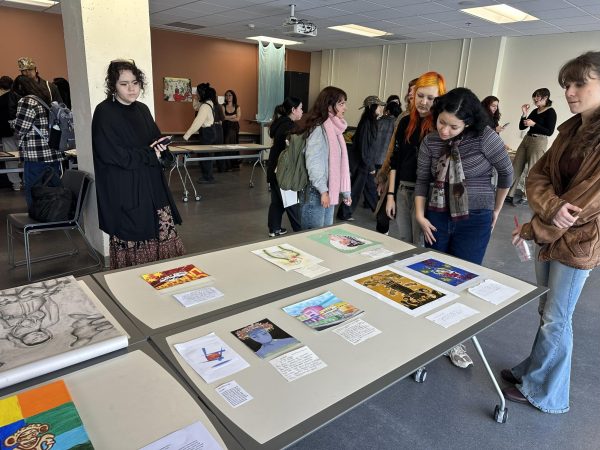
“Revolutionary,” “memory,” “myself” and “history” were some of the words students used to describe their self-created artwork at the AURA exhibition, an event sponsored by the Spanish modern languages and literatures program in Room 121 of the J. Paul Leonard Library on Thursday.
The display showcased 56 works of art created by students in the ARTH 301: Latin American and Latino/a/x Art. The classes are taught by Ana Luengo, coordinator of the Spanish program at San Francisco State University.
The name of the exhibition comes from a concept by philosopher Walter Benjamin, who considered the aura of the projects to be a unique, unrepeatable quality of the original work of art.
Luengo said her class saw the opportunity as a way to protest artificial intelligence while connecting Luengo’s teachings about Latin American resistance into their own artistic experience.

“It’s important that we reflect on what happens when democracy is truly in danger, when totalitarian regimes are imposed and what happens to the citizens and to art,” Luengo said.
AURA was planned in three phases, beginning with teaching students the theoretical aspects of art, while encouraging them to reflect on it from their own experiences, perspectives and interpretations. In the second phase, Luengo encouraged her students to seek out Latin American artwork in Bay Area museums and then to work in groups.
With this foundation developed, the students learned critical aspects of Latin American art, which helped them create art that resonated with them through what they learned in class and demonstrated resistance, a key element of this exhibition.
“Some of them were very touching because they had to do with images of their own families or migrant experiences,” Luengo said. “I’ve even cried with some of them because I found them very powerful, very well done and with very strong messages.”
Amanda Magaña, an art student, shared her work, “La Soldadera,” which pays tribute to her great-grandparents who fought alongside Pancho Villa, a revolutionary figure in Mexican history.
“I have a connection, a blood connection to this historical movement and the historical events that happened,” Magaña said. “I think it’s important to really showcase my lineage. I guess it’s in my blood to this day, just to be engaged politically and to fight for rights.”
Magaña said she is learning not to be afraid to get involved in her community and to participate politically, especially because her parents were worried about safety amid fears of Immigration and Customs Enforcement raids.
“It’s interesting how history repeats itself,” Magaña said. “They were fighting a dictatorship and we’re headed towards that. I hope they will feel inspired to politically engage themselves and educate themselves on history and how it’s continuing to affect us to this day.”
Andrea Coronado, a studio arts student, presented her piece titled “In Our Common Places, Common Remembrance,” inspired by the feeling of attachment to customs, ancestors and traditions, even when one cannot return home.
“We carry those feelings and those grievances and the pain, and also just our culture, wherever we go,” Coronado said.
Coronado’s featured work depicts an altar at the back of a bus. Coronado said she thought about the people who use it daily, like herself.
“I would like for people to maybe find those moments where they’re thinking of home, and even if it’s in the bus or in the street or in places where we don’t really find beauty,” Coronado said. “Take all those feelings or those emotions, wherever they go, just find expression in almost common places throughout a routine of everyday lives.”
“Chinga la Migra” is another one of the paintings exhibited at AURA created by Emma Schlossman. An art student inspired by street art, especially from Puerto Rico, Schlossman describes her piece as “disruption.” Schlossman used a more limited color palette, aiming to create contrast with paint, pen ink and paper. The piece took a stance against ICE and federal deployments nationwide.

“I hope people feel inspired to be more outspoken and not just stand by while violence is being inflicted upon people,” Schlossman said. “I think it connects to resistance because at the end of the day, especially during this time when people of color and my marginalized communities are being victims of our own government.”
Alyssa Mallari, an art history student, attended AURA to support her friend, who is in Luengo’s class.
“I think it’s really cool how everyone from different backgrounds and upbringings are coming together to make some really cool art in different ways, different mediums,” Mallari said. “It’s important to know where we are and the history behind that and the community because we’re in a pretty predominant Latino community in California.”
Luengo said the event not only explores the theme of art in humanity and the role of lived experience, but also strengthens the community beyond the arts.
“With the use of so-called artificial intelligence, art is in danger,” Luengo said. “Art is the expression of a person’s experience and emotions, which are related to a political, historical and social context, and a machine simply cannot do that.”
Elvira Perpinya • Nov 23, 2025 at 2:04 am
Ana congratulacions to you and all your students. They really did a very interesting job, that will help them to create community and will give them strength. Thanks for sharing. xxxx