




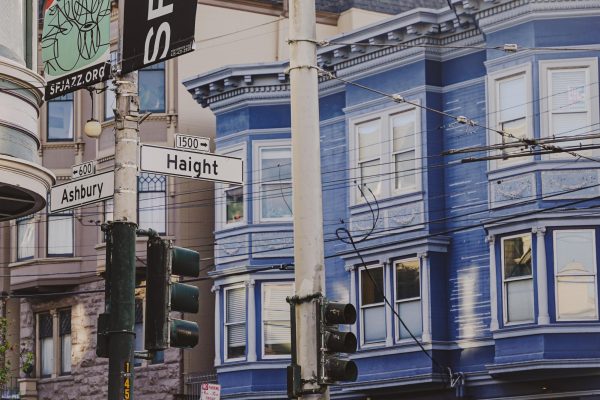
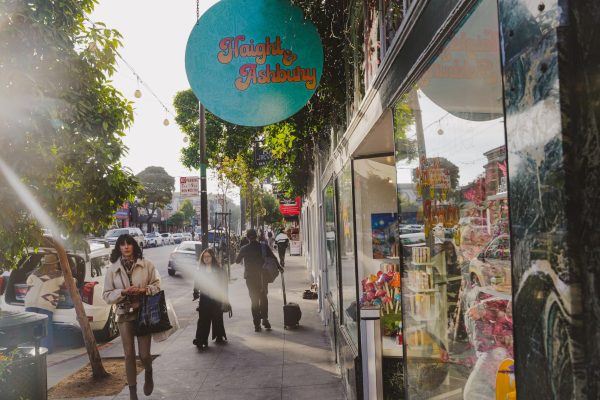
Tourists and locals crowd Haight Street every week, hunting for the best deal on Carhartt jackets, Harley-Davidson T-shirts and rare designer pieces. Behind the scenes, business owners and locals argue that the booming scene comes with growing pains of oversaturation, theft and questions of what it means to be the Haight in 2025.
Haight Street has been the center of counterculture and creative expression even before the Summer of Love in 1967. Today, it draws vintage lovers from all over the world. The boom of vintage stores opening has brought success to local owners, but also challenges: competitive pricing, repetitive inventory and security concerns. Despite this, the Haight brings people seeking a glimpse into the historical neighborhood with a vintage T-shirt to match.

For shop owners like Andrew Limos, owner of Blue Bin Vintage, Haight Street has become San Francisco’s version of Melrose Avenue in Los Angeles or Soho in New York. Limos recounts visiting the Haight in 2018 with friends, taking BART from the East Bay to shop vintage.
“I want it to be more than a vintage store,” Limos said. “We want to host events, collaborate and bring people together.”
Shoppers are drawn to vintage for one-of-a-kind pieces, better quality and more sustainable options compared to fast fashion.
San Francisco State University art history and international relations student Yasmine Ryan is a part-time employee at several Haight vintage stores. As someone who’s been working on the street for about two years, she’s seen more and more stores pop up.
“The amount of thrift stores we have is kind of absurd. It’s taking over the entire street and a lot of it isn’t that affordable,” Ryan said. “Usually you have a variety— furniture shops, gift shops — which we do have, but they’re not as shopped at because of how many thrift stores are on the street and how many young people they attract.”
With 16 vintage stores spanning between Stanyan Street and Masonic Avenue, customers are experiencing shopper fatigue. The price of the item has become the deciding factor. For business owners, competitive pricing is a balance: charge too much, and you lose the sale; charge too little, and profits vanish.
“A young person with not much money is just going to go to the next store over and just try to find the same item for half the price,” said Eric Candias, vintage reseller and former employee at 2nd STREET.
Candias added that prices reflect the street’s high rents, but at the same time, stores also need to monitor and match competitors’ pricing in order to retain customer interest.
“Even though most of the people I see on the street are high schoolers and college-age people, I feel like it’s not fairly priced,” said Milla Cacho, a studio art student at SFSU. “There are no student discounts anywhere.”
Many customers expect thrift-store prices, but there is a clear distinction between a thrift store and a vintage store. The price of items in the Haight reflects more than just the piece of clothing itself. The cost of a single shirt reflects the effort put into sourcing and its rarity. Every item is curated, cleaned and prepared with care — hours go into getting the inventory ready.
Some stores in the Haight operate under a new variety of consignment stores. Instead of taking in clothes from the public, the brick-and-mortar houses vendors who own a rack and can sell their brand. The vendor pays the shop a rental fee for the space and keeps the remaining profit of the sale.
“Many customers don’t really understand the ins and outs of the vintage business,” said Sam Corvera, an employee at Blue Bin Vintage and vintage reseller. “Some people like the prices, some don’t. It’s up to our discretion.”
In addition to extensive preparation, theft and safety are constant concerns owners have to take into consideration.
San Francisco crime report data shows that at the Haight-Ashbury intersection alone, there were 576 reported incidents between 2020 and 2025, ranging from drug sales, and theft to burglary, battery and grand theft auto.
In 2025, the SFPD Park district, which covers the Haight-Ashbury, Cole Valley, Inner Sunset and other nearby neighborhoods, had over 900 reported larceny theft cases. Of these cases, over 50% are from the Haight-Ashbury neighborhood.
Candias said that theft was a constant issue at 2nd STREET, the designer consignment store where he was employed, and that staff would frequently face verbal abuse from customers. He also recounted two incidents where a car crashed through the store’s entrance and was looted.

Even with these risks, Haight Street’s vintage shops tell a story bigger than itself, reflecting the neighborhood’s shifting character as a whole.
Christian Beaulieu, longtime local and business owner, is reopening Club Deluxe, an iconic jazz bar on Haight Street, in January 2026. According to Beaulieu, the closure in 2023 was due to a combination of landlord disputes, pandemic aftermath and renovations. Living in the Haight since 1999, Beaulieu feels a personal sense of hope for the near future of the neighborhood with “new bars, new energy, new owners and new enthusiasm.”
“There’s lots of momentum with local attention,” Beaulieu said. “The Haight-Ashbury is becoming a new version of itself.”



Neal Wong • Dec 6, 2025 at 10:19 am
Vintage stores in the Haight is new? Alcatraz Island must be a new thing too.
Sofia • Dec 15, 2025 at 6:41 pm
Looks