
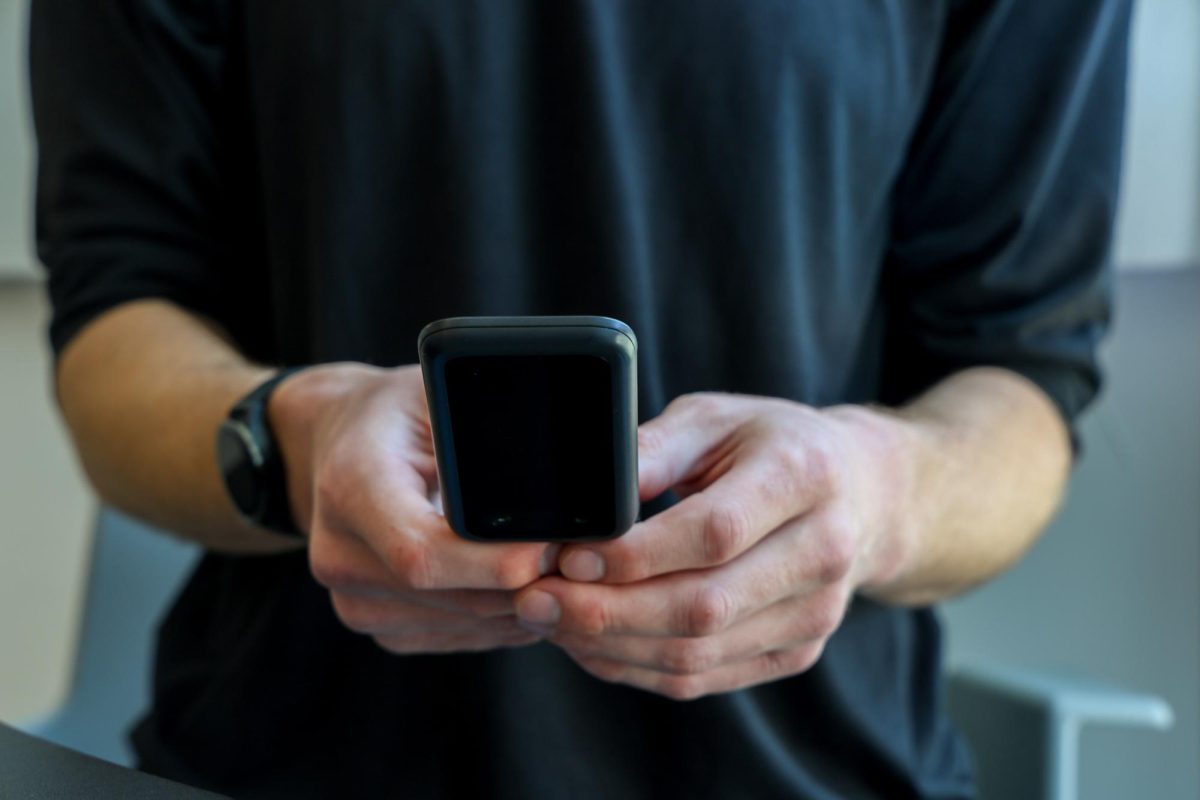
When second-year art major Amy Arevalo broke her iPhone last summer, it turned out to be a blessing in disguise.
Fed up with the performative nature of social media that she’d grown accustomed to in high school, Arevalo realized how much it was hindering her ability to form meaningful connections as a college freshman.
“Everything’s so dystopian… even if you don’t post anything, you’re still getting people to perceive you a certain way,” Arevalo said. “There’s so many hidden rules behind it. I didn’t want to be a part of that.”
A friend introduced Arevalo to r/dumbphones, a Reddit community of over 175,000 weekly visitors who’ve ditched their smartphones
in favor of the kind of bare-bones mobile devices that were all the rage before the smartphone revolution. No social media, streaming or sophisticated cameras, just calls and texting.
Arevalo’s attempts to digitally detox started with deleting apps like Instagram and TikTok, only to redownload them in a matter of weeks. The muscle memory of doomscrolling lingered, manifesting in her personal photo library rather than a social media feed.
The average cost of a flagship smartphone exceeds $1,000 due to AI-driven production costs, meaning the prospects of owning the latest iPhone or Samsung Galaxy model is beyond the scope of affordability for students like Arevalo.
“It was going to be too much to invest in a whole new phone,” Arevalo said. “I was like, ‘you know what? I’m just going to take the jump. I’m going to buy a flip phone.’”
As Gen Z Americans clocked in an average of nine hours of screen time in 2025, 81% of Gen Zers expressed a desire to unplug from the digital world. Searches for “dumb phones” and “flip phones” in the US have increased 20% and 50% respectively since 2021, according to Google Trends.
“As generations that only grew up with smartphones now enter into education and the workforce, a lot of them have encountered this reality of digital fatigue,” said Jose Briones, a digital minimalist whose dumb phone reviews have amassed nearly 14 million views on YouTube. “As a result of this, a lot of them are also interested in finding alternatives to this issue.”
Is this newfound fascination for obsolete mobile tech purely symptomatic of Gen Z’s ongoing cultural revival of early-to-mid oughts aesthetics, or could it signal a bubbling market in the search for the perfect antidote to digital burnout?
Regardless of the future of the trend cycle, analog technology — from MP3 players to physical media — remains a growing curiosity among the country’s youngest share of tech users. While nearly half of Gen Z adults remain committed to the all-in-one smartphone lifestyle, over a quarter reported a moderate to strong interest in owning a “dumb phone” in 2024. Moreover, Gen Z accounted for the largest share of dumb phone ownership across the generational spectrum at 16%.
Arevalo was a dumb phone user for three months. The first few weeks without a tiny supercomputer at her fingertips took some getting used to. To navigate the city, one of the everyday conundrums smart technology has virtually eliminated, she jotted down turn-by-turn directions and bus routes on the back of old postcards in place of Google Maps.
“It was pretty fun, but for sure not as reliable,” Arevalo said. “It can be pretty dangerous if you’re going out at night, but it got the job done most of the time.”
Sitting with the silence once filled by an endless stream of content, Arevalo fell back in love with drawing and writing. The sense of inner solitude that came from not being tethered to a screen was epiphanizing.
“I genuinely felt like I had a clear head,” Arevalo said.
When her Fall 2025 semester started, Alvarado noticed that the quirky inconveniences that came with using a flip phone in 2026 started interfering with her productivity and social wellbeing. From needing constant connectivity for Duo Mobile and Canvas to feeling out of the loop on what her friends were up to without Instagram, she was back to an iPhone not long after.
“I did such a good job staying away from that stuff just to get pulled back in. Everyone’s on social media,” Arevalo said. “It’s going to be around you all the time. That was really disappointing.”
Several studies conducted over the last six years have identified correlation between social media-induced fear of missing out and negative mental health outcomes for Gen Z users, including increased feelings of anxiety, loneliness and obsessive scrolling habits.

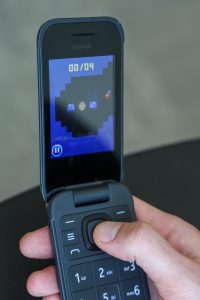
Jackson Everett, a third-year broadcast and electronic communication arts major, switched to a Nokia flip phone last October as a “daily driver” to replace his Google Pixel after failed self-disciplinary efforts to curb his screen time. Despite staying off social media, he still fell into the habit of mindlessly scrolling Reddit threads or YouTube Shorts.
“Addiction is a strong word for it, but it’s definitely the same feeling of a slippery slope,” Everett said. “At a certain point, I was like, ‘I don’t really want my phone to do that much stuff anyway.’ I really just wanted to make calls, texts and if I get really lost, give me a map home.”
Despite Everett’s efforts, even those basic tasks pose difficulties with a flip phone. He can’t open web links unless emailed to him, group chats or third-party messengers are out of the question, and he’s unable to receive texts from certain phone numbers entirely.
From contactless payment, QR codes, document scanning and bare-bones utilities like calculators or alarms, dependence on smartphone technologies is nearly impossible to avoid. More than half of American adults report relying on their smartphones even while at home, and a fifth of American adults say they cannot function without them at all.
For Everett’s lifestyle, this means keeping his old Google Pixel on standby at all times. It’s usually sitting in the trunk of his electric car for things like charging at stations which require an app to pay, texting friends internationally via WhatsApp or checking his email.
Despite these challenges, he’s still committed to the flip phone lifestyle and the benefits of being mostly untethered to a smartphone. Even though several of his classmates have expressed curiosity in making the switch, he recognizes that it’s not a one-size-fits-all approach.
“20 years ago…the idea that we would all be designing our lives around pocket computers seemed weird, and now the idea that you wouldn’t do it seems weird,” Everett said. “When everybody is using one thing, it’s hard psychologically to want to do something else because you feel like you have to justify it.”
For those who aren’t ready to take the full plunge into dumb phone territory, Everett believes a striking “middle ground” between the digital and analog world might be the most realistic approach.
Second-year English major Liliana Schapero was eager to preserve the social connectivity of smartphones and social media without the urge to doomscroll. This came in the form of Beeper, an all-in-one messaging app. Having controlled her cross-platform scrolling urges, she replaced the time spent glued to a screen by knitting scarves for her friends and hosting craft nights in her dorm.
“I’ve been trying to find small little weird things to fill my time with,” Schapero said. “I’m more present in my friendships and also just present more in general.”
Fourth-year broadcasting major Justin Morales made a New Year’s resolution to reduce his screen time. He started with doing yoga twice a week and attending Unplug and Play Collective, a screen-free hangout built around a shared culture of digital detox through analog activities.
“Everything felt very intentional… like reconnecting with some kind of inner child,” Morales said. “It’s a connection to myself that I’ve been neglecting quite often…having this connection with yourself [and] your physical body is really important.”
Unplug and Play was started over a year ago by 37-year-old Sasha Josephs, who saw the need for third spaces in the Bay Area that were “completely analog.” Josephs, Morales and a growing roster of volunteer hosts,, have since hosted hangouts across the Bay Area, including a weekend retreat in the California Redwoods last spring.
Running a community space in the city means all hands on deck. James Hennessy is a member of SF Commons — a commonspace in Hayes Valley — who’s been able to dedicate time to helping Unplug and Play run smoothly.
“If you’re doing it solo, there’s a little anxiety that there’s something important you missed,” Hennessy said. “If it’s a group effort, you can act a lot better with it.”
Even if the impracticalities of switching to a dumb phone outweigh the benefits, there’s no shortage of ways to establish a healthier, more intentional relationship between yourself and the digital world.
One solution on the rise among Gen Z is the revival of single-purpose devices to curb time spent on a smartphone like MP3 players, e-readers and digital cameras. Even the simple act of limiting access to distraction-inducing apps to a few hours a day can greatly improve sleep and reduce adverse mental health effects.
“You may not be able to have a dumb phone full time, but that doesn’t mean you have a smartphone full time either,” said Briones. “If you are able to find pockets of time within your day where you can either turn off your smartphone, enjoy more offline and maybe a weekend where you get to try out a flip phone…I think that’s the biggest win.”
Arevalo found herself gravitating towards digital cameras, camcorders and even explored the possibility of investing in a Sony Walkman in the future. She still daydreams about one day being able to convert to a dumb phone for good, but society’s dependency on smartphones shows no sign of slowing down, making it challenging to truly unplug in the way she would like to.
“I’m stuck using this phone, but I definitely want to do it again.” Arevalo said. “It’s all baby steps… I hope there’s a lot more options for us in the future, and I think there will be.”
Xpress Magazine staff reporter Grace Pastene contributed reporting on Unplug & Play.