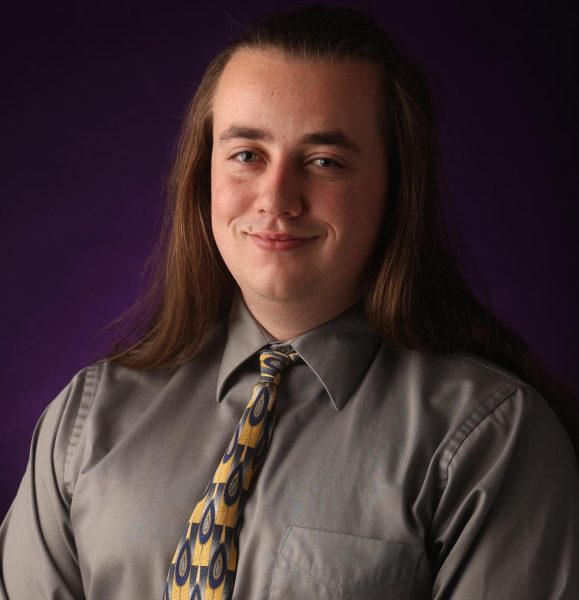



Two clomping cowboy boots, one red “Make America Great Again” hat and an extra-large American flag are three essentials Eli Mehrling carries with him during political discussions.
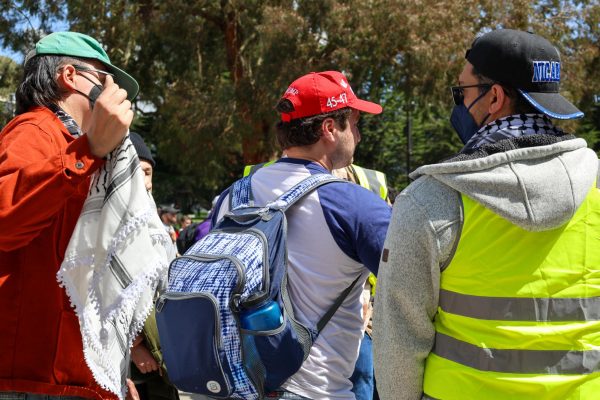
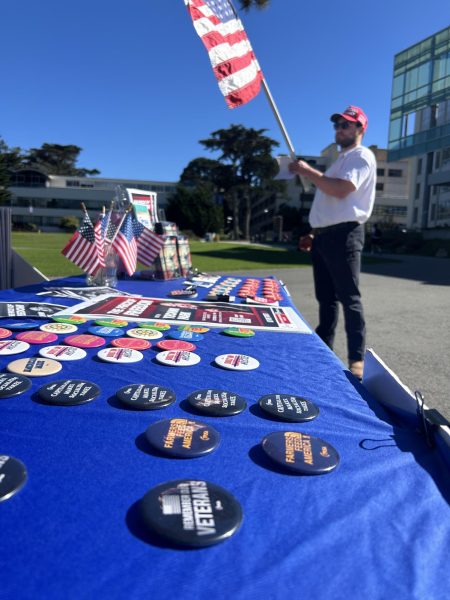
On Monday mornings, Mehrling, along with other members of San Francisco State University’s chapter of the national conservative organization, Turning Point USA, can be found in front of the Cesar Chavez Student Center with patriotic buttons, flyers and miniature flags, standing in anticipation for someone to approach.
The goal isn’t to enrage, he said, but engage.
“When we talk to people, my goal is to show them one conservative, and show them that that conservative is actually a person,” Mehrling said. “I think that does affect a lot of people. When people see us out there, maybe they’re less afraid to express their own political beliefs.”
A Pew Research study found that a majority of Democrats and Democratic-leaning individuals describe colleges as at least somewhat open to a wide range of opinions and viewpoints. For Republican and Republican-leaning individuals, fewer than half agreed with the statement.
SFSU’s predominantly liberal campus stands on diversity and inclusion, but amid an increasingly polarized country, conservative viewpoints struggle to be expressed without pushback.
In this semester alone, the university’s TPUSA chapter has dealt with flying saliva, passersby tampering with their table and, on occasion, altercations requiring campus police.
Mehrling welcomes debate and doesn’t back down when defending his values — something that has gotten him into heated arguments.
“I think a lot of people really, truly believe you’re evil if you’re conservative,” Mehrling said while recalling a TPUSA tabling incident. “I had one girl at a table and I was like, ‘OK, so you really believe in the fascists? In that case, do you think I should be dead?’ And she was like, ‘Well, yeah.’”
Mehrling hasn’t always been an outspoken conservative. In earlier days, he and his family actively demonstrated for Black rights and legalized gay marriage. While growing up in a diverse household with two mothers on opposite ends of the political spectrum — one progressive and the other conservative — he gravitated toward the former.
It wasn’t until he moved from California to Arizona and worked a blue-collar trade job with more right-leaning people that he “pretty much completely transitioned.”
Flash-forward a few years later, Mehrling stepped onto SFSU’s soil to study civil engineering and saw a deep divide in social acceptance.
“This campus is very accepting of one type of audience,” Mehrling said. “Intolerant people, if they’re the minority, they preach tolerance, and if they’re in the majority, they go back to being intolerant.”
Michael Bar, chair of the economics department and the SFSU TPUSA chapter’s adviser, presses the importance of protecting free speech and student rights to tackle Mehrling’s observation of the campus’s “evil” conservative stigma.
Bar cited an email that Carleen Mandolfo, SFSU associate provost for faculty affairs, sent to department chairs after Trump was re-elected in 2024. Mandolfo insinuated that the election results caused a collective “gutted” feeling for SFSU and further expressed her disapproval of TPUSA’s campus presence.
“I wish there was something, anything comforting I could say, but instead I need to let you know that to add insult to injury, it’s been confirmed that on November 12, our student organization, Turning Point USA, will be hosting detransitioner Chloe Cole…” the email reads. “Some of our community chose to try to shut her down, completely understandably… Should you have the opportunity and as it feels appropriate to you, consider reminding your faculty that Turning Point wants nothing more than to provoke our community into another media circus.”
Behind closed office doors, Bar expressed his disapproval for the mass email and called it hurtful to go after a “legitimate student organization” that has been approved on campus.
“It seems to me like this is a suppression of freedom of speech on campus,” Bar said. “She’s inciting against the only organization that would bring speakers that challenge some of the radical views that are being taught to students on campus.”
Both Mehrling and SFSU TPUSA chapter president Takumi Sugawara described being assigned essays in communications classes with biased narratives that had to be shaped to the liking of their professors. However, the two students approached the situation differently, and for Mehrling, that meant meeting expectations to earn a passing grade.
“I have to write essays about how much I hate myself,” Mehrling said. “[In] all these essays, the solution is ‘white men did the wrong thing and now we have to remedy it,’ and that felt kind of offensive. I’m paying to learn how bad I am. I always wrote what the teacher wanted. I feel like I was a chameleon.”
Rather than follow the status quo, Sugawara faced the possibility of a poor grade by writing his truth.
“I was kind of rebellious in a way,” Sugawara said. “If they didn’t like it, screw you. I couldn’t just do it because I could get good grades. But I at least tried to be honest with myself.”
Associate professor of international relations Scott Siegel sees things more simply. Siegel said because of the campus’s political environment, it is common for professors and students to have similar mindsets.
Siegel said educational systems face two directions: Do students feel safe to say what they want to say? And do professors and academics feel safe to say what they want to say?
“At SF state and being in San Francisco, we’re all on the same page on a lot of things that you can take for granted,” Siegel said. “You have students that assume it’s OK for gay people and transgender people to exist. You can assume that everyone should have civil rights and that the city uses appropriate language for certain things like pronoun usage, [using] the word undocumented. There’s lots of assumed knowledge that won’t get you into conflict as opposed to if you were at a different college in a different state.”
Political party values have changed over time, and Siegel said today’s conservatives have deviated from the traditional “pro-business, lower taxes and less government” identity he remembers.
“Then conservatives is like socially conservative, like against gay marriage and pro-traditional notions of the family and traditional pro-notions of gender. Then you can still have rational conversations, it’s like notions of law and order and anti-drug policies,” Siegel said. “Now it’s just, are you for Trump or against. That’s basically what it is now. There’s just so few conservatives here, how would you ever know whether it’s a safe [environment] or not.”
Outside of assignments and essays, Sugawara has gotten into classroom disagreements. He recalled a discussion where he said he spoke against “people who say colorblindness is bad.”
“The America that I know is Martin Lurther King, civil rights and that you shouldn’t be judged because of the color of your skin but the content of your character,” Sugawara said. “Two classmates really spoke against me, saying that because of the oppression of Black people experienced throughout slavery, in order to feel that pain, they need white people to experience that,” Sugawara said. “I don’t know if anyone agreed with me but if they did, they didn’t speak up.”
Sugawara said this type of interaction is nothing new to him, but he noted in this instance that there wasn’t yelling or fighting. But what he noticed most throughout these interactions was the political biases of his professors.
“I was disappointed when the professor wasn’t really neutral,” Sugawara said. “She was very on their side and it was kind of passive-aggressive. If the professor is not neutral and if the classroom is heavily left-leaning and then, well, how can we move forward?”
Yet there are times Sugawara feels rewarded for sharing his opinions. After a heated class discussion on abortion, where he supported anti-abortion values, another student praised him for his confidence.
“One guy who came up to me and he was like, ‘I don’t agree with what you’re saying, but I applaud you for standing up to your own views, even though the other guys were pro-choice,’” Sugawara said. “That really struck me, and that really made my day.”
Sir Nana Opoku-Boamah, an electrical engineering student and Ghanaian immigrant who came to SFSU in 2023, spent his first semester weeding out true friends. By using values of “family units, God and the country first,” as a guiding force, he was able to find his place on campus.
“When I’m speaking with mostly Democrats, I wasn’t able to speak freely like that,” Opoku-Boamah said. “And of course, once I just started dropping [my] values, everyone is like, ‘Oh, not me. I’m not for this.’ In order to see if they think like me, behave like me, I tried to put it in a question form.”
It wasn’t until Opoku-Boamah came across Turning Point USA that he felt his morals were reciprocated. Opoku-Boamah said he can be persuasive and enjoys civil dialogue with others on campus, but rather than completely join the group, he remains a supporter and self-proclaimed “bodyguard.” He believes that to keep peace during political discussions, both sides should be open to understanding one another, even if it doesn’t equate to affirming others’ ideology.
“When they [opposing sides] start speaking, it’s shutting down before they hear anything,” Opoku-Boamah said. “You hear something you don’t like, and we start to fight. But if you want to do it in a moral way, we get to sit down. I am OK for them to try to understand. So then it’s on them to decide whether to go with this idea or just do what they want to do.”
According to left-leaning individuals like history student Elias Garza, there is space for conservatives to express themselves on campus. Garza reasons that San Francisco’s liberal landscape leads to liberal schools.
“It’s a fact of life that this campus and the city in general are pretty left leaning,” Garza said. “So if you’re on the right, you’re going to be met with a little resistance. But I wouldn’t say that you’re silenced at all.”
Students already know TPUSA’s spot on campus. In deciding that engagement isn’t worth his time, Garza said he gets annoyed, but it’s easy to ignore it.
“You don’t have to let it ruin your day,” Garza said.
When experiences are geared toward political hot topics, they can seep their way into classroom settings. In SFSU’s “Contemporary Moral and Political Issues” course, Mary Weigel, a graduate teaching associate in philosophy, applies a range of present-day issues, like racism, abortion and climate change, to in-class discussions.
Weigel said she is grateful that discussions are civil, and although there are disagreements in the “philosophical sense,” she doesn’t label them as arguments. Student enthusiasm, fueled with outside reflections, behind class discussions is what has created a warm environment to learn and truly engage with the content.
“It’s kind of hard to think about how those things come apart, philosophical and political,” Weigel said. “I don’t really think that they come apart very cleanly at all. I would say students are often bringing in insights from things that are happening in our government or in their social lives.”
Although students possess passion and interest, Weigel notices that there are some who drive conversation with their excitement for topics and others who remain quiet. As a remedy, she tries to make equitable discussion time and will call on them “so they don’t get bulldozed.”
Despite efforts like Weigel’s, evidence shows that discussions can become one-sided. From a more left-leaning perspective, political science student and member of the political science student union, Diego Huerta, conversations in his classes are dominated by perspectives on the left.
“I guess liberal or leftist viewpoints are being supported, but it depends on the professors,” Huerta said. “I think the professors kind of act as a mediator in class a lot of times. I have professors that I would view as being more moderate, and then I’ve been in a position where I’ve been shut down.”
In Huerta’s experience, professors often play devil’s advocate for class discussions, encouraging independent thinking rather than imposing ideologies on students.
“What I notice in poli sci, they don’t throw material at you a lot of the time,” Huerta said. “There might be [some] of the crop that sort of do very different approaches and they want you to consider these points in a serious way.”
A similar approach is found in Weigel’s class, where she keeps her personal political values to herself as not “to make any of my students feel like they’re saying something wrong when they’re first working through these ideas.”
Political science professor Rebecca Eissler facilitates her political science courses with different sentiments. Eissler said it is a disservice to her students if she doesn’t share her beliefs on class topics as it creates a layer of respect between student and professor.
“There’s a moral component to the discussion that I’m not going to equivocate on,” Eissler said. “I am also trying to let the students speak first. There is absolutely a potential downside to it, but at the same time, I do think if I were to do more equivocating, or try to hide my own views, more than a fair chunk of students would actually respect that less because they see a lot of these issues as questions of right or wrong.”
At the beginning of the semester, Eissler set ground rules with her students that included addressing any presidential administration with actual titles, devoid of name calling and instead providing articulate reasoning behind opinions, in order to become scholarly conversationalists.
“Particularly when we’re discussing politics that we’re living through, we do all have it
[an opinion],” Eissler said. “But I don’t think there’s a single political science major who doesn’t have a personal opinion. And I’m not saying leave your opinions outside of class, but also think about how you’re communicating.”
Eissler isn’t naive to the campus political climate and recognizes there may be a small conservative population within her classroom. She isn’t sure how many there are and admits that such individuals are probably less vocal in class, but notices that central conservatives need tough skin to dwell both educationally and socially.
Eissler said conservatives will most likely have a harder time on this campus and need to evaluate if its liberal setting can meet their needs.
“Students have to decide, ‘Do I feel comfortable listening to alternative viewpoints than my own?’ and that is a little bit of a downside,” Eissler said. “And so the centrist folks, I don’t think it’s that much of a problem. They chime in, maybe they learn some things, they’re making friends, they’re going to do just fine. But I think people who are genuinely conservative, not just conservative but right leaning, or right political ideologies, they’re not going to enjoy the political science department.”
Siegel explained how a professor’s decision to share their political opinions and values can have a direct impact on a student’s decision to interact with the class.
“Every professor has to really be conscious of whether they’re saying something that’s about the knowledge that they’re trying to convey or their personal opinion,” Siegel said. “If it’s their personal opinion, because it’s coming from a person of authority, the student may feel like, ‘Oh, is my opinion wrong because this person in authority has said it?,’ ‘Or B, who is this person to tell me that my opinion is wrong just because they’re in a position of authority?’”
This semester, Siegel is teaching “International Relations Through Cinema” and “Introduction to International Relations: Politics, Economics, Environment, and People,” where class discussions range from the economics of developing countries to the pros and cons of President Trump’s trade war. Siegel said he is careful not to label “what is good or bad.”
Siegel has noticed a recurring phenomenon with his students — they aren’t interested in relevant current events. He concluded this is for two reasons: the lecture hall holds over 50 students, making it difficult for seminar-style discussion, and the more likely cause being students wanting to get a grade and move on.
“Students here overall are a little detached from current events,” Siegel said. “They’re more interested in completing their assignments and doing what needs to get done. Even though I teach international politics and very hot-button issues, I don’t think a lot of my students pay attention to the news.”
Thought-provoking political dialogue is what Jordan Tirona said he lacked from his time at SFSU. Now a 2024 alum from the political science department who worked on the Kamala Harris campaign after graduating, Tirona said political diversity is important in gaining understanding of political opposites — something that isn’t possible without contributions from each side.
“I’m conscious that I’m not taking up too much class time, but if people aren’t talking as much, I think that’s the big problem with political diversity at the school,” Tirona said. “It isn’t that there’s just a lack of opinion, it’s a lack of people wanting to contribute. Are they being politically segregated out or are they just anti-social or they didn’t do the homework or they’re just tired?”
When Sugawara came to the U.S. from Japan in 2022 as an international student, he noticed differences in the level of patriotism among his American-born classmates.
Sugawara came to SFSU from Japan with a fear of President Trump and a passion for America. He explained that Japanese politics is policy-driven and contains multiple parties as opposed to America’s ideological two-party system.
“I think the Japanese population is not as ideologically driven as America is,” Sugawara said. “Some parties can be conservative or traditionalist on the social policy front.”
As a Ukrainian immigrant, Bar attests to the phenomenon Sugawara describes. His liberal political tendencies were transformed when he came to the U.S. Bar said this realization presented itself when he couldn’t recognize or align with what “this campus represents, the most radical factions within the Democratic Party,” including the support of late-term abortions and the acceptance of illegal immigration.
“I did not leave the left, the left left me,” Bar said. “The left moved so far to the radical Marxist left that I think I remained in the same place.”
It is because of this change in common political ideologies within the left that he said he aligns more with conservative students. Bar filled the adviser position for SFSU’s TPUSA chapter when former adviser Jeff O’Toole stepped down. O’Toole left after receiving threats for defending the group when anti-trans athlete activist Riley Gaines came onto campus for the first time.
O’Toole is a student engagement analyst — a staff position that doesn’t hold tenure protections. With his identity rooted in his Christian faith, O’Toole said he became TPUSA’s adviser because his beliefs align with the group’s on social and fiscal issues. But when fellow staff distanced themselves, he chose a quieter method of advocacy.
“I decided I couldn’t take that kind of heat, I’m a staff, not a faculty, and faculty have more protections than staff,” O’Toole said. “I just felt like it was frustrating and I was sad. Now looking back, it was all worked out, but at the time, it hurt.”
Bar is a tenured faculty, which provides more protection for his job. He said it has allowed him to continue helping TPUSA with new tabling techniques that he hopes will reach across the campus’s political divide.
“I try to promote civilized and respectful debate,” Bar said. “I encourage Takumi and other officers from TPUSA not to conduct heated debates. Not to use any insults and mostly promote freedom of speech. Promote defense. To encourage students to look for different views, for different angles on political issues.”
Conservative events on campus are known to bring controversy and have become a thorn in the sides of students and staff with differing political ideologies. Bar is trying to change this image and expose SFSU to conservative ideologies.
“Students during this process are exposed to opposing views, opposing evidence and they learn these skills of critical thinking, of coming up with their views and how they explain their views,” Bar said. “So after attending those events at TPUSA, they learn how to defend their views, their opinions and why they hold certain views.”
According to Bar, the campus supports organizations centered on diversity with Diversity, Equity and Inclusion programs such as SFSU’s Center for Equity and Excellence in Teaching and Learning. The CEETL’s website states it is geared toward the support of diversity, social justice and the exchange of ideas and shares resources for anti-racism and oppression.
To Bar, these are “nice sounding words but unfortunately completely empty words” and said “the most important diversity is not this artificial diversity of gender, race, sex.”
“Go outside to the hallway, and you will see that we are actually one of the most diverse departments,” Bar said about the economics department. “When you look at gender, ethnicity, all the superficial features, we are one of the most diverse. But the true diversity, that’s the one that I would want to see on our campus. It’s the diversity of thought.”
Elizabeth Song is an accounting student and the vice president of TPUSA. In voicing her beliefs, she believes there doesn’t have to be agreement, but simply a mutual respect and understanding.
“It’s important, especially in San Francisco, where it’s just a big echo chamber, to voice a different opinion and voice a different perspective,” Song said. “For these people here, they haven’t heard a different perspective in their life. That’s why they tend to lean left. But when I do actually have conversations with them when we’re tabling, I think that they do realize that the right isn’t so crazy or isn’t who they thought they were.”
At one TPUSA tabling interaction, a student screamed at the group, according to Song, and took a picture of Charlie Kirk that was on their table and did inappropriate things with it, while onlookers applauded her.
“That was discouraging because even if you agree with what she’s saying, you see the way she’s behaving and you’re applauding that,” Song said. “If it was switched, and that was someone from my side acting like that, I would be so embarrassed.”
Song said she knew liberal ideologies dominated SFSU before making her decision to study here. Yet, she and other SFSU conservatives believe there is value in speaking out – and within that is freedom.
“It’s kind of freeing even though you do get attacked sometimes,” Song said. “It’s just freeing to fight for the truth and stand for the truth and not compromise on your morals.”