


“On a national level, I can say this nicely, but I’ll say it more directly – we’re fucked,” said Aaron White, a physics and astronomy lecturer faculty who attended yesterday’s California Faculty Association Zoom town hall.
Despite a sense of hopelessness, White, together with faculty and students, worked in cohorts to prioritize action that could bring San Francisco State University toward the light at the end of the deficit tunnel.
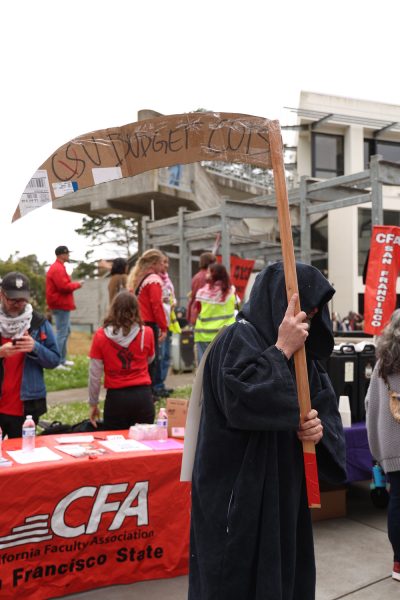
The town hall comes as SFSU prepares for more austerity following under performing enrollment, despite the majority of the California State University system experiencing an increase in enrollment.
A major topic discussed during the town hall was the raising of professors’ teaching requirement to four courses per semester instead of three, sparking concerns among faculty who worry the added strain – compounded by past layoffs – will prevent them from meeting all their students’ needs, worsening the school’s academic quality.
Tenured/Tenure-track faculty Vice President of SFSU’s CFA chapter James Martel cited hiring documents which set the workload for professors at three courses per semester, claiming that the increase is illegal under California law.
“If you worked at a coffee shop and they increased your hours by a quarter, but didn’t give you more money, that would be illegal right?” said Martel. “I don’t see it any different from us.”
CFA members also went over additional issues facing SFSU, including the university’s adherence to the Huron Consulting Group’s recommendations.
“Huron group is a very notorious consulting firm … [Huron] has nothing to do with academia,” Martel said. “They don’t know how it works. They don’t care.”
Some faculty feel that decisions made by SFSU’s administration have sowed doubt and mistrust, feeling the administration is either not consulting with faculty enough, or blatantly disregarding their concerns in favor of what Huron Consulting Group has advised.
“We are not being given either time or extra compensation to adapt, transfer and reorganize our classes around the increased course sizes that are being used to fill the budget gap,” design professor Hsiao-Yun Chu wrote in the town hall’s zoom chat. “This lack of recognition for the real impacts of increased class sizes is an item of concern.”
Calls for votes of no-confidence against CSU Chancellor Mildred García, as well as SFSU President Lynn Mahoney, emerged as some no longer feel they prioritize student and faculty’s best interests.
White argued that administration salaries across the CSU should be greatly reduced. Acknowledging the counterargument that it wouldn’t fix the budget deficit, White strongly believes teaching far out values administrative processes and thinks pay should match that.
“The other argument I’ve heard is that, if we didn’t pay [administrators] that much, then we wouldn’t be able to get quality candidates,” White said, “I would argue we have never seen … evidence of the quality candidates that that’s supposedly meant to pay for.”
Another concern raised by Africana Studies professor Mark Allan Davis, who is the representative for the CFA’s Council for Racial and Social Justice, was the CSU’s ability to view and potentially control, content from professors’ Canvas courses.
“We have to go to the university to administer our own intellectual property,” Davis said during the town hall. “That’s a problem for me because that means all of our courses are held on to by the university, and they can keep on holding onto it and I think that is a very important matter.”
Members of the Student Union were in attendance in solidarity with the CFA. The Student Union previously collaborated with the CFA during the Red 4 Ed week last semester.
“I’ve really enjoyed the classes and what I’ve learned. I see the value that all these professors have,” said fourth-year industrial design major Ruth Sarasohn, an elected leader in the Student Union. “It’s just a shame that they’re being let go because of mismanagement.”
Words like “despirited” and “rough” were used by Martel to describe the current feeling among faculty, especially after the mass layoffs of lecturer faculty. But despite the circumstances, Martel is motivated to continue working with the CFA.
“I find the antidote to despair is to get involved and organize and push back,” Martel said. “I always tell people you’re never going to regret standing up for yourself, or your collectivity, so I’m feeling full of energy and charge and hope.”
Others in the CFA, even those with more bleak outlooks, share similar sentiments.
“I’m pessimistic but haven’t made it all the way to nihilistic just yet,” White said in an email. “We’re riding a speeding dumpster fire towards a cliff, but we haven’t flown off the edge just yet.”