
Intro
Seamus Geoghegan: 00:05 – 00:013
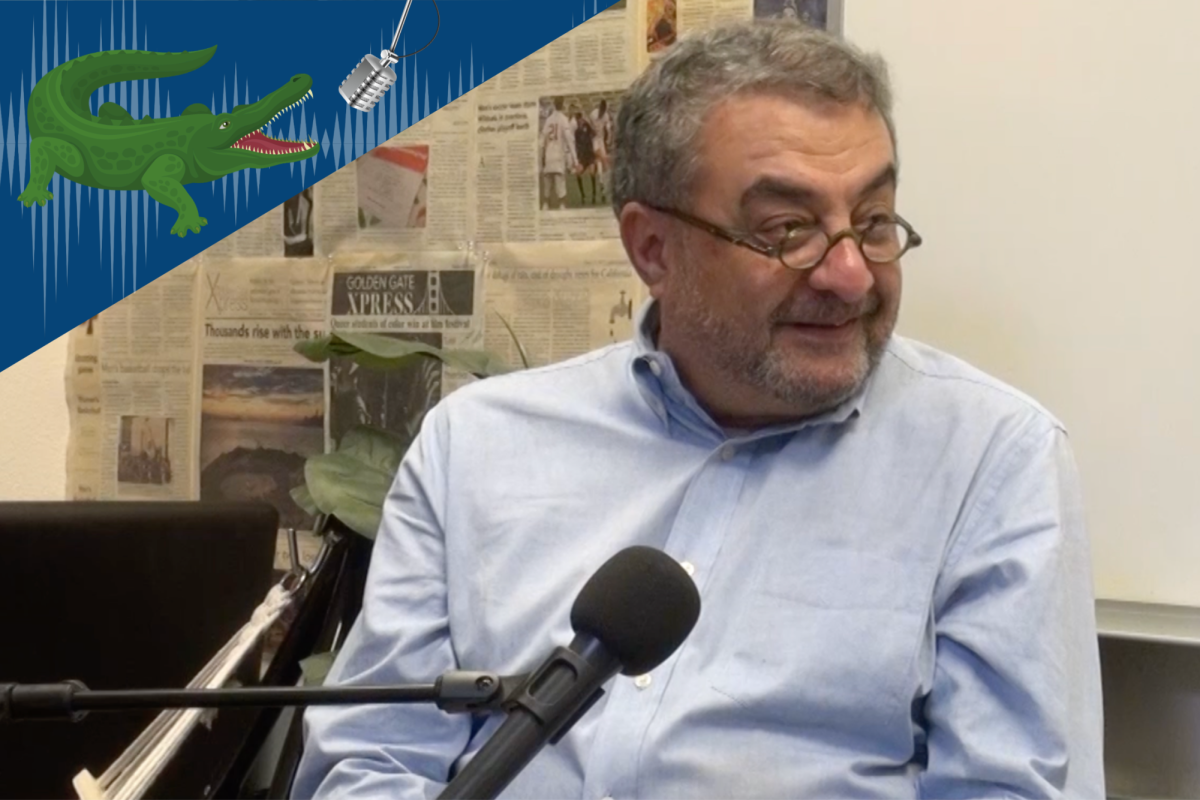
Hello, and welcome to another episode of Gator Talk. I’d like to welcome the acting dean of the College of Liberal and Creative Arts, Dr. David Landy.
David Landy: 00:013 – 00:014
Thank you for having me.
Interview
Geoghegan: 00:014 – 00:25
Thank you for coming in, good morning. Firstly, I’d like to know more about your educational background. So yeah, just tell me about your time at Bard College and the University of North Carolina.
Landy: 00:25 – 00:43
Okay. So, before I went to Bard, I grew up in New York City. And in New York City, when you’re going into high school, everybody takes a test .And if you do well enough on the test, you get to go to the good high school, and I was really good at taking tests. So I went to this high school, and it was a very big high school.
00:43 – 01:11
It had a lot of people, and they were very driven and, you know, and that’s it. They were very driven people, and there was a lot of grade pressure and stuff like that. A focus on success, and I did not care for that at all. And so, I applied to Bard. I don’t even know exactly why, but it was small, and it was liberal arts, and when I got there, it was great because everyone there was just a bunch of weirdos.
01:11 – 01:40
And no one was — People were driven because they cared about what they were studying, and not at all because they cared about what grades they got or what they were going to do in their future life, and I love that environment. Yeah, anyway, so I was at Bard, I spent four years there. I started out — I thought I was going to be a creative writing major, and I thought, well, if I’m going to do writing, don’t you have to know everything first? And so I started with a class in ancient Greek philosophy because it seems like that’s okay, we’ll start at the beginning.
01:40 – 02:11
And I did not like that class at all. But, I took some more philosophy classes, eventually became a double major in literature, and philosophy. But then all my literature papers started turning into philosophy papers, so I ended up just doing philosophy. I did not know there was no career preparedness at that college. There was nothing like, “Here’s how you get through life.” And so I, around junior year thought, well, I seem to be pretty good at being a student, so I should see if I can just do that for a living.
02:11 – 02:51
And so I went, applied to a bunch of places, ended up going University of North Carolina, Chapel Hill because there was a guy there who worked on Vic Einstein and Kant, and those were the people I thought I was interested in. Yeah, I was there for seven years. So philosophy, when I was there, I still didn’t know anything about the way the world worked. And so I didn’t know if I was going to do contemporary philosophy of language and philosophy of mind, which were my sort of areas of interest, or history of philosophy. Ended up doing history of philosophy and, let’s see. Graduated. Got a job for a year as a visiting professor at Wake Forest. And then in 2009, started here. And I’ve been here ever since.
Geoghegan: 02:51 – 02:57
Yeah, and I wanted to ask about that. How did you end up here at San Francisco State University?
Landy: 02:57 – 03:31
Okay, so, back in the day, if you were a philosophy graduate student, they published an actual physical newspaper called Jobs for Philosophers. And so every day, every year, if you’re going to the market, you would open it and you would flip through really fast seeing what all the best jobs were. Anyway, so I came, flipped through, my then girlfriend, now wife was standing there with me. And actually, two jobs made us pause. One was at Bard, and I was like, “Oh, yeah, that’s — I got to go back!” And the other one was here and my wife is standing there, and she jumped over my shoulder like, “There! San Francisco State!”
03:31 – 04:07
And the philosophy job market at the time, I don’t know if you can imagine, but there wasn’t much of a market for professional philosophers. And so it was a rough market, and I was like, well, obviously that would be the dream job. That’s I mean, that’s an amazing place, an amazing university. I knew that — I don’t know if I should say you or we because at the time it was you, but now it’s we — we have a very, well-regarded, philosophy M.A. program, and I was excited about that. But I was like, I’m never going to get that job. Not in a million years, but. So. But maybe I could get the one at Bard.
04:07 – 04:34
Long process, ended up basically getting both, and those are the only jobs I’ve ever gotten. I really like what was going on in the department here. It felt like a place, I could thrive in a place that was doing good things, and that was really exciting. And there were just so many opportunities in and around the university in the city that we came here.
Geoghegan: 04:34 – 04:48
Yeah, amazing. And as you mentioned, you’ve taught in the university’s philosophy department since 2009. How is your background as a professor and the former chair of that department prepared you for this role that you’ve taken on of acting dean of LCA?
Landy: 04:48 – 05:32
Oh, that’s a good question. I mean it does seem so important to being dean that you understand, like, I think it’s really helpful to have been on the ground. right? And know all the particular things, like all the specifics. I feel like I have a decent sense of what it is like to be a faculty member or what our student body is like. Paperwork. So I was also, I was graduate coordinator of our department for ten years. So like, I know all about advancement to candidacy forms and proposals for a culminating experience. And I worked on revising curriculum and advising. And, you know, I know what it’s like to have to balance research and teaching.
05:32 – 06:01
And I know what the needs of our students are when it comes to teaching. So yeah, it feels like — I’m sure someone could do this job without having been faculty here, but I think it’s really helpful. Both because you know — how to put it — you know the vibes. But you also know, like really hyper specific things. Like, I know that if you file this one piece of paperwork past this date, well, then you’re gonna have to file this other piece of paperwork and things like that come in handy every once in a while.
06:01 – 06:15
Just having, and then we’ve been here for 15 years, right? Like, I know I am learning a lot as dean about how parts of the university work that I never interacted with, but at least I have, like the foundation about the other parts that I interact with a little bit more.
Geoghegan: 06:15 – 06:26
Yeah, that kind of transitions to my next question about your transition to this new role. What’s been the hardest aspect of that transition from teaching to a more administrative type of role at the university?
Landy: 06:26 – 06:59
That’s a good question. The hardest thing and the worst thing are different. The worst thing is not teaching because I love teaching. I didn’t realize how much I love teaching until I became chair. I started teaching less and doing more administration. And then being in the classroom was the best part of every week. It was like, oh, here’s just like three hours a week, where I get to just talk about philosophy and talk to, you know, incredibly smart, interested students, about something that we have a mutual interest in. And so that was just amazing. So I miss teaching a lot.
06:59 – 07:45
The hardest thing. The hardest thing for me is probably just, there’s a lot I don’t know. So when I was faculty, I knew our, especially our graduate program really well. When I was chair, I got to know this whole new host of things pretty well by the end. And then becoming dean is like, whoa, we have an amazing college. So early on, I did some tours around some of our various facilities, like — did I do a journalism tour? I don’t think I did a journalism tour. But I did a tour of the design spaces and the theater spaces, and I was just like, wow. The line space, spaces, theater, cinema. It just blew my mind. Like, I didn’t know half. I didn’t know that any of this stuff was going on.
07:45 – 08:09
And then immediately dread set in. It was like, “Oh, there’s a lot of logistics involved in this.” Like, we need people to keep all this stuff, like running and clean and repaired and things like that. So, there’s just a lot that I don’t know, and I feel like I’m learning a ton and literally every day. And so it’s just the hardest part is just feeling like, oh, man, I want to make sure not to screw up the whole college, through ignorance.
Geoghegan: 08:09 – 08:15
Totally. Yeah. What was that most recent thing that you’ve learned on the job?
Landy: 08:15 – 09:03
What’s the most recent thing I’ve learned on the job? That’s a really good question. We’re transitioning from, I think the… there’s something going on where the CSU is having everyone transition to a new human resources system, you know, like, whatever the system is, where you go in and do things. I mean, I guess I don’t know if it’s something I learned, but, I am — there’s lots of reason to think that’s going to solve a bunch of problems and be really helpful, but transitioning from one system to another system seems like it’s a terrible thing to do. So, one thing I’ve learned is. Oh, God. Here’s another one.
Geoghegan: 09:03 – 09:28
Yeah, amazing. I wanted to ask: It feels like we’re in a state of crisis here at San Francisco State. Despite more funding from the state for the California State University system, we’re still, our university is still struggling with budget. Where do you anticipate the College of LCA being hit the hardest in terms of budget, and what are you doing to ensure that further faculty and classes aren’t being slashed?
Landy: 09:28 – 10:08
Yeah, good. I think that the place I’m hopeful is a place that we will be hit hardest is a place we’ve already been hit. So this semester, we did work with departments. So one thing that happened was, the university took a look at the number of degree programs we have, and it turned out we had, from my understanding, twice as many degree programs as similarly sized universities. Which is great, right? Because of course, amazing to give students a wide variety of opportunities to study a million different things. It’s not — just for the record, it’s not a million.
10:08 – 10:52
But, the thing about that is, for every degree program, there are required courses. And so we have an obligation to the students to make sure all the courses required for that degree are offered. And that means that the schedule has to be very, very big, right? The course schedule has to be very, very big. And that’s fine. Except that with a shrinking budget, that becomes, that requires hiring more people to teach those classes. And in some cases, in some cases there would be classes; Well, so the fundamental problem is that means that, for every degree program, there’s a number of extra courses have to go on the schedule just for that degree program.
10:52 – 11:32
And if a degree program doesn’t have very many students in it — like some were as low as, like two students in a year or something — that means we’re putting on a lot of classes to serve a small population, and we kind of just couldn’t afford to do that. So, we have talked to departments there and some departments have agreed to discontinue some of their smaller, some of the smaller programs around the college, which is, I mean, in one sense, a real tragedy. I don’t want to see any of those go away. On the other hand, when you’re dealing with a shrinking budget, I feel like what you have to do, like, our top priority is to protect students, and to protect the integrity of the degrees we have.
11:32 – 12:07
And so, given that we weren’t going to be able to put on the same number of courses, we had to figure out which courses could conceivably come off the schedule with the least negative impact on students. I think we’ve done a lot of that work now. I’m hopeful that — there are probably a few more things we have to look into — but I’m hopeful that most of it is done. And now we can be in, we can sort of pause, take stock, and then start building cool new things with the courses we have and, you know, potentially new courses that we can find room for in the schedule.
12:07 – 12:26
So, I think that’s the hardest thing. I think, like I said, I think hopefully a lot of that process has already been completed or is sort of in, you know, in process. And then your question was what to do to protect students? Was that your question?
Geoghegan: 12:26 – 12:33
And faculty. What can we do to ensure, or what are you doing to ensure, that further faculty slash courses aren’t slashed?
Landy: 12:33 – 13:04
Yeah, that’s a really good question. So, one thing, one thing that we’ve done a lot of this semester is, so if we have faculty and they’re primarily teaching in programs that are closing, is we were — we’ve been working with those faculty to find other programs that they can teach in. So, part of what’s happening on campus is we have fewer faculty, or we expect to have fewer faculty, but those faculty aren’t necessarily — so the faculty aren’t necessarily where we need them, right?
13:04 – 13:12
So they’ll be demand in one program, but not enough faculty to teach it. There’ll be too many faculty and, not really too many faculty, but just, some programs will have more faculty than they need to teach their curriculum.
13:12 – 13:32
And so we’ve been working with faculty to see if there are fits elsewhere on campus for some folks, and our priority has very much been. So number one is like, well, we have to serve the curriculum. That’s kind of the most important thing that the students are here to study, to study. And we need we need to put on the courses that they need to graduate.
13:32 – 13:52
And two, we’re really trying really hard to find faculty, homes where they feel comfortable and supported and where they feel like they can take those really successful courses that they have and integrate them into a new program. Right. So, if you have a course being taught in one department, that’s really popular and students want to take it and faculty want to teach it like, yeah, great.
13:52 – 14:22
It may be that we can’t put on all the programs, all the courses for that degree program, but if we can say, move that faculty member and course to another department and have that course count for a degree in that department. You know, fantastic. Now, yeah. Now we’ve sort of, we’ve managed to trim the schedule, without taking off the courses that matter most to the students and faculty.
Geoghegan: 14:22 – 14:38
Yeah. You mentioned that some of those programs have been being discontinued. I’m thinking of anthropology. Yeah. And some of the languages. Yep. Do you expect you said we’re kind of maybe going into building things. Yeah. Are we entering that phase or are we going to expect more further discontinuities?
Landy: 14:38 – 15:09
I wouldn’t be surprised if there were a few more discontinuities. But I think we are. I’m hopeful that we’re transitioning to a phrase phase where we at least stabilize, and start having conversations about, okay, now, now that this is where is that where we’re at? What comes next? What do we need? Like, are there holes in the curriculum that we still need to fill?
15:09 – 15:31
Are there exciting new programs that we want to get onto the books? Are there other ways to integrate those new programs and programs we already have? So I guess what do I think? And I guess I would say there might be a few more proposals for discontinuance or temporary suspensions over the next year, like next academic year.
15:31 – 15:53
But that. And I mean, the other thing about the curriculum is it’s always changing, right? So what’s what has a lot of students right now and what is very relevant right now? My job with the pace of change in the world, who knows in, you know, a year or five years or ten years, where student interest is going to be and what teaching is even going to look like.
15:53 – 16:14
So I think we do have to stay flexible, but most of the answer to your question is, I feel like we are more stable and more… we’re on a better footing now than we have been before. And I’m hopeful that the pace of change in reaction to the budget is going to really slow down now.
Geoghegan: 16:14 – 16:27
It was recently brought up in a budget committee meeting and reported by Golden Gate Xpress and expressed that there haven’t been enough VSIP takers. The Voluntary Separation Incentive Program. How much of a concern is that for you?
Landy: 16:27 – 16:48
Yeah, it’s a concern. So, again, the idea is we have lower enrollment than we have in the past. And that means that we have, that we have our budget is proportionately lower, and there are fewer classes that we need to teach around campus just because we have fewer students to take those classes.
16:48 – 17:10
The VSIP was a way of giving faculty an incentive, right? An opportunity to voluntarily separate from the university, which would both address both those issues. Right. Most of our budget, I don’t remember the number, but some very high percentage of our budget goes to personnel. So we have a smaller budget, we need to have fewer personnel.
17:10 – 17:28
So that was one reason for the VSIP. And also, if those faculty separated, there will be fewer classes that we teach. Which is okay, because we have fewer students now. So faculty. So. Right. It was, they had a goal for how many faculty they were hoping would take the VSIP.
17:28 – 17:55
They didn’t make it. Yeah. I mean, it’s a reason for concern because it means we’re going to have to find a different way, different way to address the budget shortfall. And also a different way to figure out what faculty are going to teach, in the curriculum. I will say that there is a sense in which that is, over my pay grade, and I’m not jealous of the people who have to figure that out.
17:55 – 18:21
But, yeah, it is a cause for concern. I think we have some very resourceful and creative and kind and rational administrators that I think are going to do their best to make sure that they protect the campus from the impact of those budget cuts as best they can.
Geoghegan: 18:21 – 18:33
A major aspect of our funding is tied to enrollment. Yep. What efforts are you making to increase enrollment within LCA? And then to your knowledge, what efforts is the university making to bring more students?
Landy: 18:33 – 18:59
Yeah, that’s a good question. So I think. Some of the enrollment, as far as I understand it, I’m not an expert on this, but some of the enrollment is tied to demographic issues that are really hard to push back against. Just both Democrat local demographic issues. So in a way, right there, when the pandemic happened, people started moving away from San Francisco in the Bay Area.
18:59 – 19:19
And that largely that was people with families who would have had students who were college age now. That there right there is as always, the housing crisis in the Bay area, also makes people move not only not only away from the Bay Area, but further out, from San Francisco itself. And commuting is hard and takes time and energy and money.
19:19 – 19:42
So there’s those things, and there’s only so much we can do about those. We are, I think the college is also a college… our understanding is that incoming students are more and more interested in, concerned about their post-graduate, career prospects. And so I think there is a pivot happening in our college, but also around campus, towards taking a more deliberate approach to that.
19:42 – 20:00
And not, you know, it’s tricky because faculty, a lot of faculty are well, it depends what department and what discipline. But a lot of faculty were trained as academics and don’t know how to get a job. So they’re not in a great position to help their students with that. But I think we are paying more and more attention to that.
20:00 – 20:18
We’re focused on degree programs also that have that built in. I think there’s a lot of talk around campus about, even if it’s not a degree program, a certificate program that you could pair with a degree. I know that there’s been a lot of talk recently about pairing, say, a career.
20:18 – 20:46
It’s hard to. Right, because. So you can call a degree program career focused, but sometimes all that. What that means is the career connection is obvious. And then sometimes there are career connections. They’re just not as obvious. So, like, we get a lot of that here in college of Liberal and Creative Arts because someone who’s like, in the humanities will develop a set of skills that is going to mean they’re going to be incredibly well prepared for whatever job they get next, right?
20:46 – 21:03
And like, if you look at salary data, I think that tends to back that up, right. Like so entering salaries for like humanities students might be lower. But like over the course of their careers, they tend to be, you know, be promoted more and move up more. And to have higher salaries or equivalent salaries later on.
21:03 – 21:26
So right, in a way, those degrees are already, career preparedness degrees is just not obvious. But there has been talk that’s saying about right preparing these degrees. Right. So you get both like the, industry specific skills that you need to make it obvious that you can do a job, but then also sort of the quote-unquote soft skills that are actually going to make you thrive in that job.
21:26 – 21:49
And I think the same is true of the arts and the social sciences. Again, sometimes the ties to industry are more obvious. Sometimes they’re less obvious. But I think the idea that what would be great for students at San Francisco State is, having a well-rounded education with discipline specific knowledge and also like critical thinking, written composition, oral communication skills.
21:49 – 22:13
So, yeah, that sounds a very good idea. So I think, yeah, I think making those connections to postgraduate success more explicit, and more a deliberate focus of the university is at least one way that we’re hoping to, to help with enrollment, attract more students because they’ll think, you know, you get a better return on investment from coming here.
Geoghegan: 22:13 – 22:29
And I had a question about that. Career readiness is a major part, as you’re saying, of the university’s goal for its students. Amidst one of the toughest job markets yet for recent graduates. Yeah. Do you think LCA graduates are leaving this university with the tools they need to get a job?
Landy: 22:29 – 22:55
I think so. I think I think we can, I’m confident we can do an even better job of that. But I do think, we have so many programs that are already, already focused on that. And I think the university has set up, set up. Well, like I said, to have a combination of the soft skills that are going to help students thrive when they get into these jobs and also the discipline specific skills.
22:55 – 23:24
So like, yeah. I think there are things we can do better. Maybe that’s more industry connections. Maybe that’s like I said, these pairing programs, maybe a certificate. Right. So that you’re, you’re already taking a major, but you get a certificate to the you, have something to show a future employer that says, well, like, not only did I do study this specific discipline, but I also had a particular focus on this, which is directly relevant to the thing that you’re hiring in.
23:24 – 23:41
But, I mean, I think our students do find a lot of success. I think I, I think we can always do better. And I think making, like, I said, making those connections clearer, and a more deliberate focus, is only going to help.
23:41 – 23:52
The California State University system has spent millions on consulting groups. Pretty much just to tell them they don’t have any money. Do you think that’s where money should be spent? And why or why not?
23:52 – 24:27
Yeah, that’s a good question. I guess the way I think of consulting groups is this. As maybe especially since becoming dean, there’s administrators, so sometimes we need information, and we don’t like, as academics, we do not like guessing. Right? We all have hunches. You all, you sort of. You have a feeling like you have a pretty good sense of what’s going on. But we don’t like that, right? We like to rely on hard data and analysis and be informed in our decision making. And quite frankly, like when you’re an administrator there, it will come up, right?
24:27 – 24:56
Oh, there are these big projects we should do right? We really need to get a handle on whatever it is. Right? Retention rates for first year students in this department. You know, just right. There’s all sorts of ways you can approach what’s going on at the university and how best to deal with it. And I think often administrators have so much on their plate with day to day operations, that, and also we only have access to so much data from our university.
24:56 – 25:21
Right. So like one thing all of to say, I think, if we want to make data informed decisions, it often does require us to go outside the university, right. And have folks with the time and energy and expertise and access to data that we don’t have. Right. So, some consulting groups, you know, are gathering data from hundreds or thousands of universities across the country.
25:21 – 25:42
Right. So we’re not going to be able to even if we could get that data, it’s not like it would take time and energy and resources to compile it all and sort it out and clean it up and then start drawing conclusions. And so, yeah, I think. I think it is. Is it the best way to spend that money? I genuinely don’t know.
25:42 – 26:03
I wouldn’t be in a position to say, I’m hopeful that the people who are in a position, are making these decisions lightly. And, you know, and it seems like not a bad idea to make your decisions with as much information as possible. And I take it that’s what we’re trying to get using these consultants.
26:03 – 26:18
I don’t know, I mean, you know, if we do it, and it turns out that the information we’re getting isn’t good or useful. That stinks. I hope we wouldn’t do it again. But I do think there’s some insights to be had from that sort of thing for sure, right?
Geoghegan: 26:18 – 26:32
Yeah, because I know I’m not sure if you’ve heard of Huron Consulting Group, but they’re not an academic consulting group. So when you’re relying on folks who aren’t in that kind of scene. The findings that they have aren’t relevant to us.
Landy: 26:32 – 26:44
Yeah I mean yeah I agree, I mean I yeah I take it they’re relevant mostly because they’re, they’re pointed at us. Right. But I think we do have to take that, take their conclusions and then make our own judgments about them.
26:44 – 27:04
Right. I think we absolutely cannot just turn over all of our decision making, to the consultants. And I don’t think anyone has done that. Either way, in my brief time as dean, the way I’ve seen that information used is as, hey, here’s some information that might be useful to you. Yeah, it is worth thinking about looking at and thinking about and thinking through.
27:04 – 27:27
Right. And I think that’s like, that’s the best we can do. Right? So sometimes you’ll get a piece, a piece of information, a report, and it’ll just be like, oh yeah, yeah, I see why that’s the case. But I know all these other things that are specific to the university that make me, you know, I don’t know, hesitate to take that recommendation or I understand that data in a way that say, Huron doesn’t, but like, yeah, got it.
27:27 – 27:54
Sometimes you get some report and it’s like, oh that’s interesting right? I don’t know, I am surprised by that or that or even that confirms what my suspicion was. And yeah, I think that’s like that’s something we have to work on. So yeah, I mean, look, in general I am pro-information, but I also recognize that that information comes at a cost. And like, there’s just going to be a balance between paying the costs and getting the goods.
Geoghegan: 27:54 – 28:18
Definitely. Yesterday, the student union sat down with university president Lynn Mahoney and Provost Amy Sueyoshi and Malcolm X Plaza to discuss their list of demands, including concerns around the use of AI. Yeah, what the university is doing to protect its community from ICE. Yeah. And more. Yeah. Where are you there for that conversation? And then, if you’ve heard of those issues, do you believe those issues are being adequately addressed by the university?
Landy: 28:18 – 28:41
Oh, good. I wasn’t there for it. I’m trying to remember where I was, but that’s totally irrelevant to the meeting or something. Yeah. I wasn’t there for it. I am aware of both of those issues. I think I am not an expert on either. I guess I don’t want to pass judgment cause I’m interested, especially around the conversation about protecting the campus from ICE.
28:41 – 29:01
I don’t… My sense was that we’ve done a decent job of that, but it sounds like maybe people have concerns, and I’d be interested to hear those. So maybe they’ll be, hopefully the issues that were raised that they’re meeting, you know, trickle down to the deans. And yeah, I would want to move on anything, where there was concern or there was more we could do that.
20:01 – 29:23
About AI, oh for sure. So actually, before I became dean, I was part of a committee that was working on a new curricular proposal for a certificate of critical AI studies. And we were trying to strike a balance because AI It’s so difficult to even wrap your head around. On that committee, we’re trying to strike a balance between…
29:23 – 29:45
We think, I think we are all pretty firmly committed to, we need to be thinking critically about AI a lot. It seems like a very big and important and kind of impactful new technology. And those things always need a lot of scrutiny. And a lot of, I think, a healthy dose of skepticism.
29:45 – 30:11
So that was part one. The part two was AI is here. And it seems like it would harm our students, to ignore it and to act like it wasn’t going to change a lot about postgraduate success. And careers and everything. And so we are designing this certificate to be to sort of have two parts. So one, a foundation of courses where AI was treated as the subject matter of critical study.
30:11 – 30:24
So, some courses that were explicitly about AI and how to think about AI and what the technology was and ethical implications of all that. And students, I think, I think the way it was designed, but it’s going through the process now and so it could have been revised in ways, I don’t know.
30:24 – 30:45
It was like, take two out of these three courses that were that, and then and then we are. Okay. But this is like an interdisciplinary cross college certificate. So now after you’ve done that, or as you’re being exposed to critical thinking about AI, go to your specific discipline and learn about how it’s actually being used in your industry or how it’s actually being talked about.
30:45 – 31:04
Right. So the idea was, get a, there are already a bunch of courses on, in the, in the curriculum in the course schedule that are explicitly, you know, such and such and AI. Right. So like in philosophy, we have some AI courses like, you know, here’s how AI is being used in cinema, here’s how it’s being treated in the humanities, things like that.
31:04 – 31:31
And so I thought was, get a critical study. But then also with that in mind, go learn your discipline specific treatment of it. Yeah. It’s, it’s, it’s an exciting and a terrifying time when it comes to AI. And I think, we have to, you know, we have to address it like we do everything, at a university, which is, scrutinize it, think about it.
31:31 – 31:42
Be very critical about what it’s doing, how it’s doing it, and how it ought to be used. But then also not stick our heads in the sand and pretend that it doesn’t exist.
Geoghegan: 31:42 – 31:48
This one. Simple. How different is LCA going to look in the next five years?
Landy: 31:48 – 32:11
Oh, that’s not simple at all. Seven. I don’t know, I don’t know. Yeah. Like we talked about earlier, we have done some curricular restructuring, and I think there is more of that to do so we are focused on before discontinuance and temporary suspension.
32:11 – 32:30
But I think there’s other kinds of innovations that are going to happen. So, again, with faculty moving from moving across departments, I expect there’s going to be some curricular revision to come with that. So, you know, and that’s great. Like in a way, expanding the boundaries of disciplines, to include new and other kinds of work is awesome.
32:30 – 32:57
And so I’m excited for that. Yeah. I mean, I expect AI to have a big impact. I don’t, I think we very much don’t know what that’s going to look like. There’s a bunch of people around campus trying to figure it out. You know, the most obvious impact is in things like writing, reading and writing with the presence of in the, in, you know, in a world where large language models exist, I do yeah.
32:57 – 33:19
So that, I expect to reshape things. What do you say, five to 10 years, five years, five years, two years. I don’t know if it’ll move as quickly as that. Because we’re a big institution and it’s hard to turn a big ship quickly. But I think that will have an impact. I think, you know, it depends on what happens with enrollment trends.
33:19 – 33:46
So there’s, there’s sort of been murmurs of our fall enrollment being up at least modestly, which is exciting. And so I think some change will happen with that. I don’t know, it’s a good question. Part of me is like, well, I like the way that our college looks now. I think it’s great in a lot of ways. I don’t want it to change. But, we do have to change with the changing times. So, yeah, it’s hard to hard to quantify.
33:46 – 34:03
I would expect that some things are going to look pretty similar. Big picture, but that there will be a good amount of adjustment and refining and innovation around.
Geoghegan: 33:03 – 34:06
Gotcha. Yeah. And of course, you’ll be president of the university.
Landy: 34:06 – 34:07
I assume.
Geoghegan: 34:08 – 34:11
What’s the biggest problem that LCA is facing right now?
Landy: 34:11 – 34:42
Biggest problem the LCA is facing? That’s a good question. I mean, there is that resource shifting problem that we, we right now, our, I mean, I guess most prominently our faculty aren’t entirely in the places where they can best serve curriculum, but we’ve been working on that, so that’s okay.
34:42 – 35:12
We always, sort of always are, budget issues around. I mean, so LCA has, like I said earlier, it’s amazing departments that do amazing things. Some of those amazing things require equipment and stuff, which I, we’ve had some success in, recently, especially, in getting funding and deploying funding to, to repair things and replace things and that sort of thing but that’s also a concern.
35:12 – 35:39
I mean, AI is a big thing, I think the humanities and arts are both going to be impacted by that in ways that it is hard to entirely foresee right now. And so we have to keep our eye on that. I don’t think a new dean that could do that could be an issue, depending how he does. Yeah, I don’t know. You know, I guess that’s, that’s what I’ve got for now.
Outro
Geoghegan: 35:39 – 35:43
Gotcha. Thank you so much for coming on. Really appreciate it.
Landy: 35:43 – 35:46
Appreciate you having me here.
Geoghegan: 35:46 – 35:45
Of course.