

Glen Powell is in a rough spot. The 37-year-old breakout star of “Top Gun: Maverick” has spent the ensuing three years chasing — and mostly achieving — movie stardom. But to what end?
Besides the aviation flop “Devotion,” Powell’s hot streak is alive and well after carrying “Anyone But You” and “Twisters” to box office gold and spearheading the success of the cute and clever “Hit Man,” which he wrote with director Richard Linklater and starred in. With the exception of the Linklater-helmed charmer, Powell hasn’t led a quality picture since being taken under Tom Cruise’s wing. “The Running Man” doesn’t change that.
The second adaptation of Stephen King’s novel of the same name, after Paul Michael Glaser’s 1987 Arnold Schwarzenegger vehicle, this more faithful presentation comes courtesy of Edgar Wright, hot off the flameout of “Last Night in Soho.” Seemingly chasing safer fare (read: IP) after that 2021 bomb, Wright’s typical hyper-stylized bag of tricks and cheeky sensibilities are almost nowhere to be found as he injects this, his first bona fide studio blockbuster, with all the energy of a napping jackrabbit. Somewhere in the slumber of this movie, there could be an Energizer Bunny ready to jumpstart a whole city. You even see rumblings of Wright’s coiled-up energy, but he never seems to care enough about this well-trodden dystopian thriller to let it free.
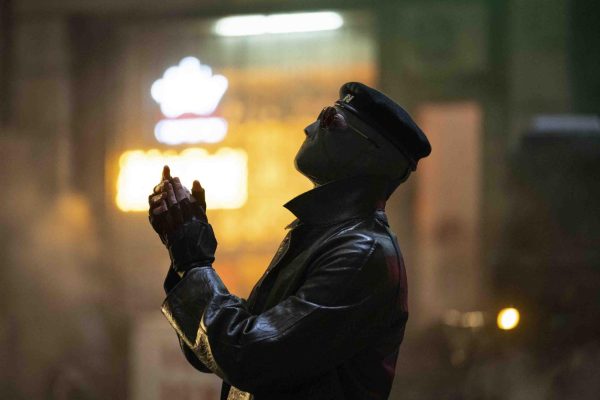
As in King’s novel, Wright’s film follows Ben Richards, a down-on-his-luck member of the working class whose fiery temper precedes him and whose funds have run dry as he and his wife, Sheila (Jayme Lawson), take care of their ailing baby. At his wits’ end, Richards signs up for a brutal competition show controlled by The Network, which seemingly controls all aspects of life in this dystopia. However, he’s forced into “The Running Man,” The Network’s brutal hunt-and-kill show after he appeals to its sinister producer, Dan Killian (Josh Brolin). Richards has 30 days to survive by any means necessary with The Hunters, Network-sponsored assassins, hot on his trail, all for the entertainment of the masses that are being kept in poverty by the company distracting them.
King’s prescience in the 1980s rings hollow today in the wake of the 2010s’ onslaught of dystopian sci-fi films, and Wright’s lack of creative vision doesn’t inspire any confidence either. Seemingly only made now because the novel is set in 2025, this remake, while far more faithful to King’s darkly satirical work, is much less biting than the quite silly and jugheaded 1987 cable classic. Much like “Total Recall,” it turns out that just by eschewing a campier Schwarzenegger predecessor and staying truer to the source doesn’t inherently boost an adaptation, but broadcasts juvenility.
Wright’s filmography often boasts arrested development as a virtue, even if textually targeted. “Scott Pilgrim vs. the World” and “The World’s End” are prime examples of Wright’s scripts valuing the wisdom in growing up and moving on, yet he can’t help but have his cake and eat it too. Both films aspire to candy-colored phantasmagoria and end up about one-fifth of the way there. This is a common shortcoming through all six of his previous films, and it’s no different in “The Running Man.”
Where this mega-blockbuster needs to make a choice between dark satire or grim reality, Wright opts for a non-partisan middle path that forebears the film’s generally centrist politics, which reheat years-old “eat the rich” sentiment in favor of any stance that may be taken as truly incendiary. Anyone looking for revolutionary politicking in their studio blockbusters is bound to be disappointed, but look to this year’s “Sinners” and “One Battle After Another” for massive entertainments whose politics and form go hand-in-hand, both aspects of which are bold enough to burst through their corporate housings. There is no such ambition in this flatly directed and highly sheeny genre outing that feels more like a product of The Network than of a work of the aspirational rebels fighting against it.

Beyond half-drawn revolutionary sentiments that follow Glen Powell’s lackluster attempt at a true-blue everyman character, this thriller just isn’t thrilling. Despite Wright’s overzealous showmanship in “Baby Driver,” that was still a wildly confident movie whose action sequences are clear and fluid and whose stakes are just the same. Here, Wright and co-writer Michael Bacall introduce Richards in such a pedestrian fashion, one hopes it’s part of a larger and more scathing satire until the realization settles in that such wit or excitement isn’t coming. Instead, the script trudges through stake-setting and worldbuilding like jury duty until the chase begins. And stops. And begins again all the way until the end. Wright’s trademark brisk and florid flourishes come as afterthoughts and each action sequence is less nail-biting than the last. Excitement should be the name of the game, but it can’t be mustered.
More disorienting than exciting is the film’s oddly star-studded and overqualified cast. Its brightest spots are Colman Domingo and Lee Pace playing support as the slickly charismatic emcee of the in-universe “The Running Man” and its brutish lead Hunter. Two crackerjack performances aren’t enough to buoy the otherwise drowsy cast that seems to understand the tiresome severity of the parts they’re saddled with. Katy O’Brian and Martin Herlihy seem imported from a more formulaic but maybe more fun movie as ancillary Runners, while Michael Cera and Brolin are confoundingly cast as the anarchist angel and executive devil on Richards’ shoulders.
Richards, upon whose shoulders the film rests, is in as rough a spot as his actor. On the page, Wright and Bacall have done the bare minimum to give this guy a personality, but that’s the perfect role for a true movie star to step into and flex his star wattage. Instead, Powell seems lost at sea with Richards’ mostly straightforward nature. Powell has built his star persona over the last four years on an earnest and charming devil-may-care visage, but that isn’t served by this milquetoast role, nor does Powell serve the oddly self-serious and coldly cruel nature of the movie. Wright’s trigger-happy yet tame and intangible approach leaves the intended-to-be-breathlessly structured and executed action feeling textureless and anonymous, especially when there is so little room for its star to shine.
Under the reign of The Network, it’s not like one expects this dystopian affair to be sunshine and lollipops. But, when coming to the multiplexes for some late fall action programming, it’s hard not to be disappointed at the rather empty offering of “The Running Man,” whose glitzy exterior and hollow interior give a stronger impression of a Network product than one with the blood of the revolution in its veins or even a steady pulse.
“The Running Man” opens in theaters everywhere Nov. 14.