
Intro
Wilson: 00:00-00:23
Every year, we have a mantra that we keep within the group of girls during that year, and then the next year, we change it. So, this year we’ve changed it again. This year, it’s called “Why Not Us?” And it’s just touching on the new group of girls, just because they’re young, there’s four young girls on the court and then two other girls on the court.
00:24-00:39
That doesn’t mean that we can’t go super far. So, like, why not us? Why can’t we go back to the national championships this year? Like age, I really feel like it doesn’t make that huge of a difference. If you could play volleyball on this court, you deserve to be here. If you’re here, you’re here for a reason.
Interview
Camargo: 00:44-01:01
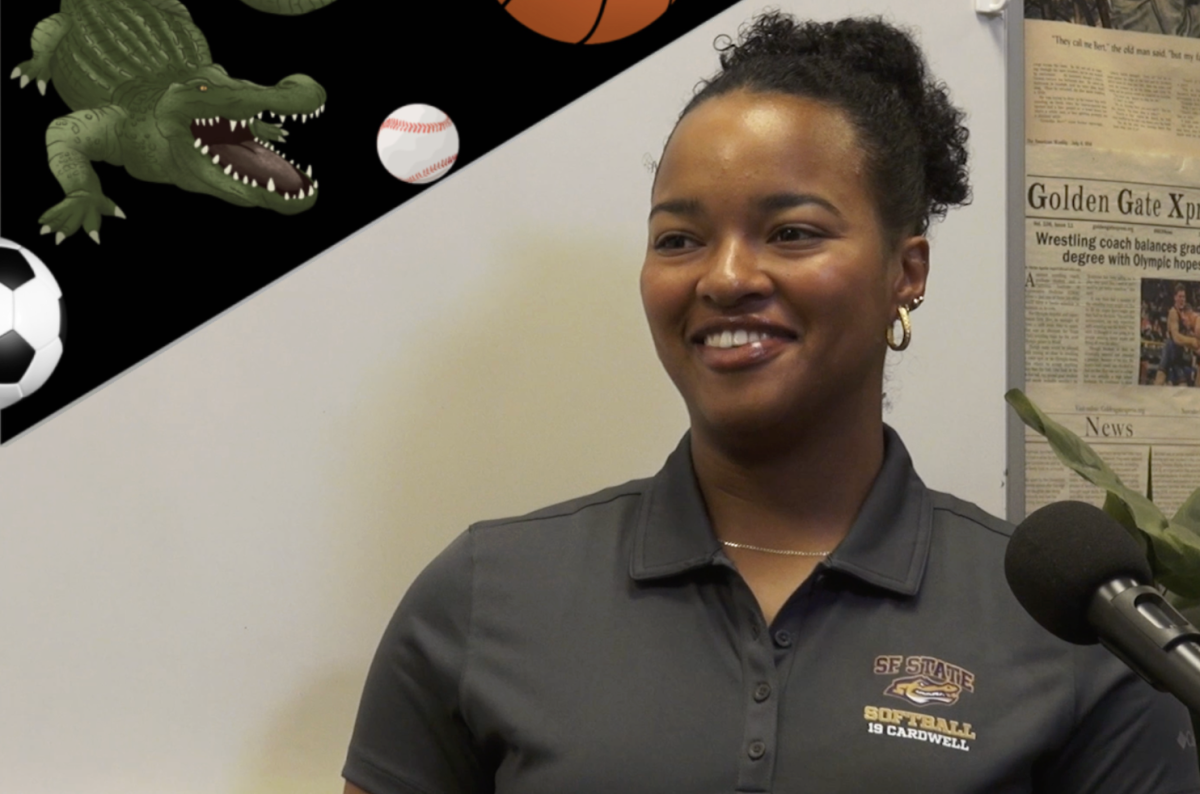
Hello, Gators. My name is Diego Camargo, and this is The Chomp podcast. And today I’m joined by Tamiya Wilson. Today, we’re going to be talking about her career at SF State, and some of the things she’s accomplished and some of the teams that she’s been on. So let’s get straight into it. Tamiya, obviously, you’ve had a pretty successful career here at SF State.
01:02-01:11
Can you talk to me about why you chose to come here? What were the different things that led you to come in here? Was it the coach? Was it the program? Can you tell me about it?
Wilson: 01:12-01:41
Yeah. When the recruiting process opened up for me, Matt reached out pretty soon, and he made my choice really easy. At first, it was a little bit hard because I was new to this, so I didn’t know how to pick a college and what was going to come with it. But I love the area. I love the weather here. That’s one of my favorite things. And also, I just really like the style of how Matt coaches, and I don’t regret that decision.
Camargo: 01:41-01:52
Who were you before you really came here? I don’t want to necessarily say you found yourself. Who were you before you came here? How have you changed since you got here?
Wilson: 01:52-02:21
Yeah. High school is actually kind of rough for me, honestly. Because I also play club volleyball, so there’s club volleyball and high school volleyball, and I felt like, with coaches, I was kind of not seen by them. And so I had to really prove to myself who I was as a player. And that was help from my parents and family. Because I felt I wasn’t good enough to be on the good team or doing the right things. So it was kind of hard.
02:22-2:55
So, going into the recruiting process, I only talked to like two or three schools, honestly, because I committed really fast. I don’t know, it was just kind of rocky. And then, coming here my freshman year, I was like, “You’re probably going to play.” It’s a big step. Going from high school to college is a really big difference. I was kind of nervous, of course, as any freshman would be, but I got into it pretty fast. And, I try to get better every year.
Camargo: 02:56-03:07
You’ve been really successful since you got in here. Can you just talk to me about your career here and what that’s meant to you? Can you give me an overall of your career from your freshman year to right now? A little small summary.
Wilson: 03:10-03:39
Yeah. Like I said before, freshman year was kind of nerve-racking. But as I got into it, of course, it helps from your team, like support. Not having support from them wouldn’t have gotten me as far as I am. And also support from my coaches. Support from family, friends and all that. Freshman year, it was kind of cool because I got [CCAA] Freshman of the Year, and it was like, “Whoa, that’s a big thing.” Then sophomore year, I’m beating my own record in kills.
03:40-04-08
And then the same thing with junior year, I’m going up every year. It’s just like people from the outside, they might look like that’s easy or it just comes naturally, but it doesn’t. It takes a lot of hard work, a lot of focus. Because on top of this, I’m also in school. I’m also trying to balance so many things at once. And then this year hasn’t even really started yet, and I beat the school’s [kills] record.
04:08-04:23
A lot of things are thrown at me, and I’m such a shy, to myself kind of person. And so, getting all the attention, it makes me proud of myself because, like I said, in high school, I wasn’t recognized for anything that I was doing. But here I’ve just gotten recognized so much, and I really love the support.
Camargo 04:23-04:31
I actually kind of want to touch on that kills record because it’s a really big milestone. That record was upheld for nearly 40 years.
Wilson: 04:32-04:34
I think it was broken in 1988.
Camargo: 04:35-04:57
What does that accomplishment really mean to you? Because it’s such a crazy record. Like you said, 38 years is a long time, or 37 years to be more exact, is a long time for a record to hold. Within your time here, you’re not even done with your senior year. That record might be untouchable by the time you’re done. What does that really mean to you?
Wilson: 04:57-05:41
It really means a lot because there’s so much sweat, so much tears, so much effort, so much time put into a sport. Being able to be recognized for it, it makes me so happy. As much as I’m shy towards everybody, I really, truly do appreciate it and the love that I get from people, and just being able, as a person, to do that, it’s insane. It hasn’t even really processed me yet. It’s such a big deal, but I’m just like, ”Yeah, you know, like whatever.” Yeah, then people bring it up to me and talk more about it. I’m like, “Oh my gosh.” Like, yeah, that’s kind of crazy. Yeah, it means a lot.
Camargo: 05:42-06:04
No, it’s insane. From my perspective, sports here really isn’t the focal point of this school. So, when stuff like that happens, it’s really cool to see. Like we said, 37 years is a long time for a record to be upheld. And, assuming the rest of the season really does go right for you, who knows if someone else might even break that record in the future.
06:05-06:25
I want to touch on last year’s team a little bit because I want to transition and talk about this year’s team. Can you talk to me about that experience of being around that team? Being around that core group of players? Because you were here for three years. You were all within the same group. Can you talk to me about what last year really meant to you and what you learned from that experience?
Wilson: 06:25-06:48
Yeah. Last year’s group of girls was so amazing, and so has every other year. But last year, we made it further than I’ve ever been, being here. And I just think having each other’s back, talking to each other, being supportive throughout every milestone, really meant the most to me, and it helped me to become a better player.
06:49-07:15
And I hope it has for other people, but now it’s just me and Aidan [Goodrich] who are the only ones that are returning this year. So, we have a whole new team, basically, with a lot of freshmen that are on the court. And I think it’s a learning process. Everybody’s still getting into it, trying to figure out where we connect, where we build trust. I think it’s going to end up being really good.
07:16-7:22
In the beginning, it might be rocky, and we have some things to work on and learn from, but then that’s only going to make us better towards the end.
Camargo: 07:23-07:37
You’re one of the impact players since you’ve gotten here. What responsibilities do you feel you have to take on now? Because you’re, I don’t necessarily want to say you’re the main person, but you’re the main person who’s returning, in a way.
Wilson: 07:38-07:59
Yeah. It’s a lot of responsibility, honestly. But I take pride in that because I’ve never had that role before. So, being able to have it now is like, “Okay. My teammates are looking up to me. They want to know what I have to say, what I have to think.” And so, I’m really just trying my best to keep them all calm and cool and not freak out because they’re all freshmen, they’re babies.
08:00-8:14
This is their first time touching a volleyball court in college. So, it’s not easy because I remember being there. So, me and Aidan especially are trying to really push them to be the best that they can and get out of that shell.
Camargo: 08:15-08:33
This is going to be your last year here at [San Francisco] State. And obviously you want to make the best out of it with this core group of girls. How does that feel knowing that this is your last season? This is the “last dance,” as they say. What are the emotions surrounding that? Especially, who knows what you’re going to be doing after.
Wilson: 08:34-09:07
Right now, it hasn’t really hit me, and I think it is because it’s so early. But I’m really proud to have come as far as I have. I haven’t hit the sad mark yet, really. Sometimes I’m like, “Oh my gosh, it’s my last first game in this gym.” Yeah, yeah. And then it’s like, “Oh,” like that’s crazy to think about. But there’s still a long way to go. So, I’m not letting the sad part come yet. I’m just trying to enjoy it, like you said.
09:07-9:16
It’s my last time doing this. I obviously won’t get the college experience again after this year, so I’m just really trying to take it all in and go slow and not rush through it.
Camargo 09:17-09:32
What is going to make this year different, that you’re excited for, that you’ve never really had in previous years? Outside of the fact that it is a new group of players and you are taking on this new responsibility, but is there anything else that you see that is different from previous teams?
Wilson: 09:33-10:01
Yeah. Building a new connection, I feel like, because every year, we have a mantra that we keep within the group of girls during that year, and then the next year, we change it. So this year, we’ve changed it again. This year, it’s called “Why Not Us?” And it’s just touching on the new group of girls, just because they’re young, there’s four young girls on the court and then two older girls on the court.
10:01-10:19
That doesn’t mean that we can’t go super far. So, why not us? Why can’t we go back to the national championships this year? Like age, I really feel like it doesn’t make that huge of a difference. If you could play volleyball on this court, you deserve to be here. If you’re here, you’re here for a reason. So I really want to touch on that.
Camargo: 10:20-10:35
What are the ways you guys are — because you said it’s building connection — what are the different ways you guys are trying to connect? Is it stuff you guys are doing off the court? On the court? Is it just hanging out with each other? What goes into building that connection, especially if it is a big group of girls?
Wilson: 10:36-10:48
Yeah. On and off the court. Off the court, we try to do things together just so that we have that bond with each other. And then even on the court, just positive talk to each other, encouragement, all that kind of stuff is going to help for sure.
Camargo: 10:49-11:12
I want to talk about your coach, Coach [Matt] Hoffman. A question I have is, what have you really learned from your time being here from Coach Hoffman? Because he’s been here for, I think, this is his 11th season. Like, going in or right around there? Can you just talk to me about what he’s done for you in your life, and getting better as a volleyball player and just all that type of stuff.
Wilson: 11:12-11:32
Yeah. Even off of the court, he finds a way to make me — try to make me smile, at least. I’m a hard one to crack. So he’s always trying to be supportive and talk to me and make sure that I’m okay. Even when we’re talking, like, sometimes he’ll be like, “How’s your family?” Like, “How’s your brother? How’s your mom? How’s your dad?”
11:33 – 11:41
So, I appreciate the little things, even though sometimes it may not always seem like it because I’m giving him attitude, but he’s great.
11:42-12:01
I wouldn’t change it for the world. He has his tempers sometimes, but, truly, he cares about us, deeper than just being a volleyball player. He cares about you as a person. He cares about what you’re doing. He makes sure that everybody’s good all the time. So, not everybody, not all coaches do that.
Camargo 12:02-12:14
We’ve talked about your successes here. What do you really want people to remember you [by] when you are off the program? What do you hope people remember you for? It could be on the court, off the court?
Wilson 12:15-12:41
Yeah. I just want people to remember me as somebody who really came from nothing, came from being nobody, to being somebody that people talk about. Because, like I said earlier, that’s not easy. It took a lot of time, and stress and work to get there. And so I just really want people to remember me as being like someone who came from 0 kills to 1,100, you know?
Camargo 12:42-12:46
For sure. Well, thank you so much, Tamiya. I appreciate you joining us today.
Wilson: 12:47-12:48
Of course.
Camargo 12:49-12:54
Well, that’s it for us here at The Chomp podcast. My name is Diego Camargo, and we’re signing out with Golden Gate Xpress.