
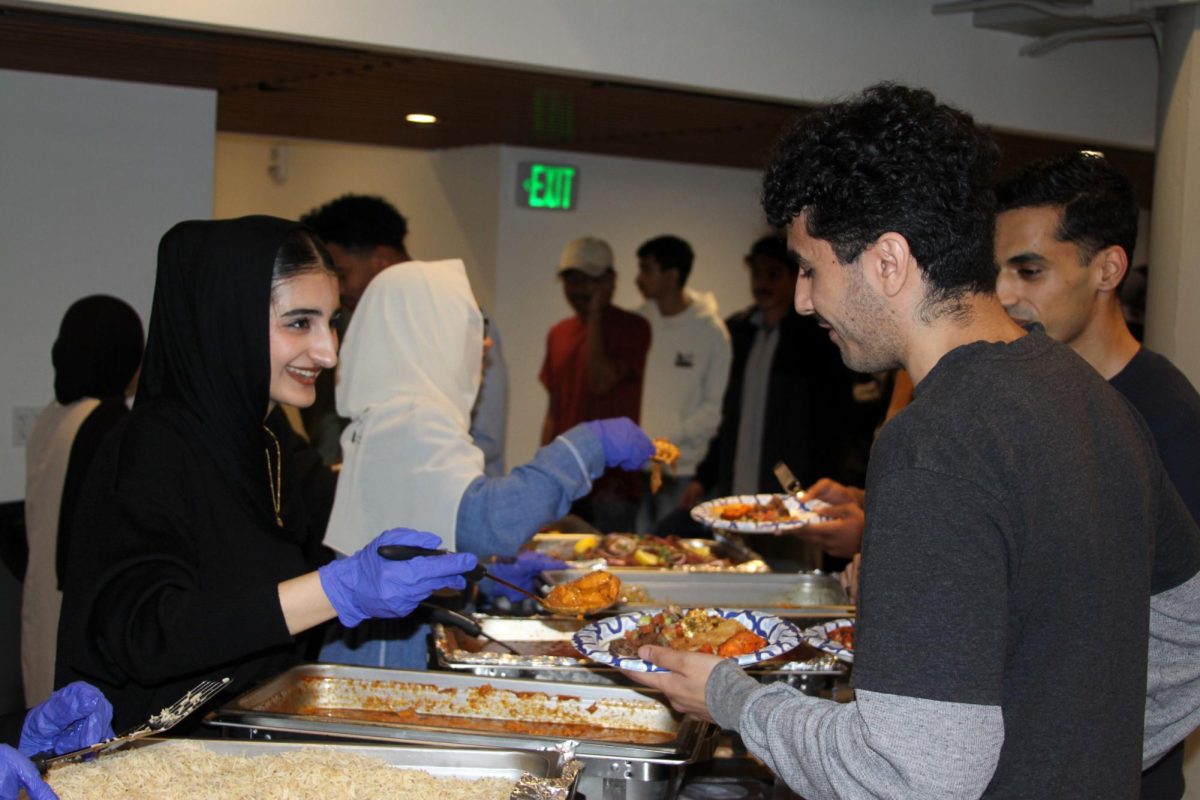
The Muslim Student Association, in collaboration with the Muslim Student Life Coordinator and the Muslim Tech Collaborative, welcomed more than 140 San Francisco State University students to start their first iftar event of the year on Tuesday.
The event hosted students in the University Club at the Cesar Chavez Student Center, where students broke their fast, participated in a group prayer and enjoyed Afghan cuisine for their iftar meal. Feb. 18, 2026, marked the first day of Ramadan month in the Islamic calendar, where Muslims around the world start fasting from sunrise to sunset. Muslims traditionally gather for large meals and break their fast with their families or in mosques.
Maria Anjum, a long-time member of the MSA and planner of the iftar events, emphasized the importance of hosting iftar events to create a safe space for the community, while ICE raids have targeted Muslim communities in the Bay Area.
“With everything going on now, it’s more important than ever to have a space for community where students feel welcome and safe on campus,” Anjum said. “That’s why it’s really important for us to host community iftars for the students, especially those who are away from home and who really crave that familial connection.”
Bilal Alkachak is an SFSU alum and is currently serving as the MSL coordinator in the Division of Equity & Community Inclusion. When Alkachak was a student, he served as the co-ed event coordinator for the MSA, and now he supports the Muslim student organizations in their academic journeys.
“Ramadan is a holy month for Muslim students worldwide, and it’s the month in which the Holy Quran was revealed,” Alkachak said. “It’s the month of fasting, family and the month of community. By hosting these iftar events, we try as much as possible to include the students who are away from their families, international students and even local students who feel that they want to be part of the MSA community”.
Mohamed Mahdee, a second-year student and men’s soccer club athlete, participated in his first iftar event at SFSU. Mahdee described his experience as amazing, looking forward to upcoming iftar events.
“I have been to different iftars with different people who are traditionally and culturally different from each other, and from my home country Yemen, where we have differences with others, but at the end of the day, MSA iftar is a good environment to meet new friends and my fellow classmates,” Mahde said.
SFSU decided to cancel the only Arab and Muslim Ethnicities and Diasporas studies program class on Islamophobia, according to a post by the AMED department, raising concerns within the Muslim community about the lack of awareness on Islamophobia.
“It’s really unfortunate to see a lot of classes being cut,” Alkachak said. “One of the main reasons is the budget cuts. It’s affecting every student, including the Islamophobia class and many other classes. But we always try to find a way to work around it. That’s why we’re hosting the Ramadan iftar here in the U-Club today, one of five iftars that’s being hosted by the Muslim Student Life Coordinator.”
Charaf Zrn, a computer science student and an international student from Algeria, saw the MSA iftar poster online two years ago, inspiring him to attend the event. Ever since then, he has participated in the iftar events consistently.
“It’s a good idea to gather everyone who’s Muslim and non-Muslim, and the community students at SF State,” Zrn said. “The location is a positive part of the event because of [it] being in the middle of the campus and easy to find. We can do good activities in the iftar event, we are meeting new people, networking with each other, and the organizers serve good food for students who are fasting.”
The MSA is planning to host five more iftar events, including a collaboration with the Bay Area-wide Pakistani Student Association on Thursday in Jack Adams Hall. The MSA is also hosting a weekly Quran circle led by various alternating scholars, Friday prayers and Islamic events after Ramadan.
“The planning of this event was a joint effort between all three clubs and [organizations], and all of them worked very hard together and were super organized to make it happen,” Anjum said. “From my experience hosting events in SFSU, I think logistics can be a little tricky sometimes, but when you have a really good team, it makes it easy to work with one another. It’s important for us to continue doing this every year as it fosters a really good environment. And with the holy spirit of Ramadan, everybody is putting in that extra effort to be kinder and patient and more compassionate.”