




As the U.S. starts to accept the use of A.I., technology experts in the Bay Area are raising concerns.
Sam Altman announced tonight he had signed a deal with the Pentagon, introducing fears that the government will be putting his company OpenAI’s technology to military use.
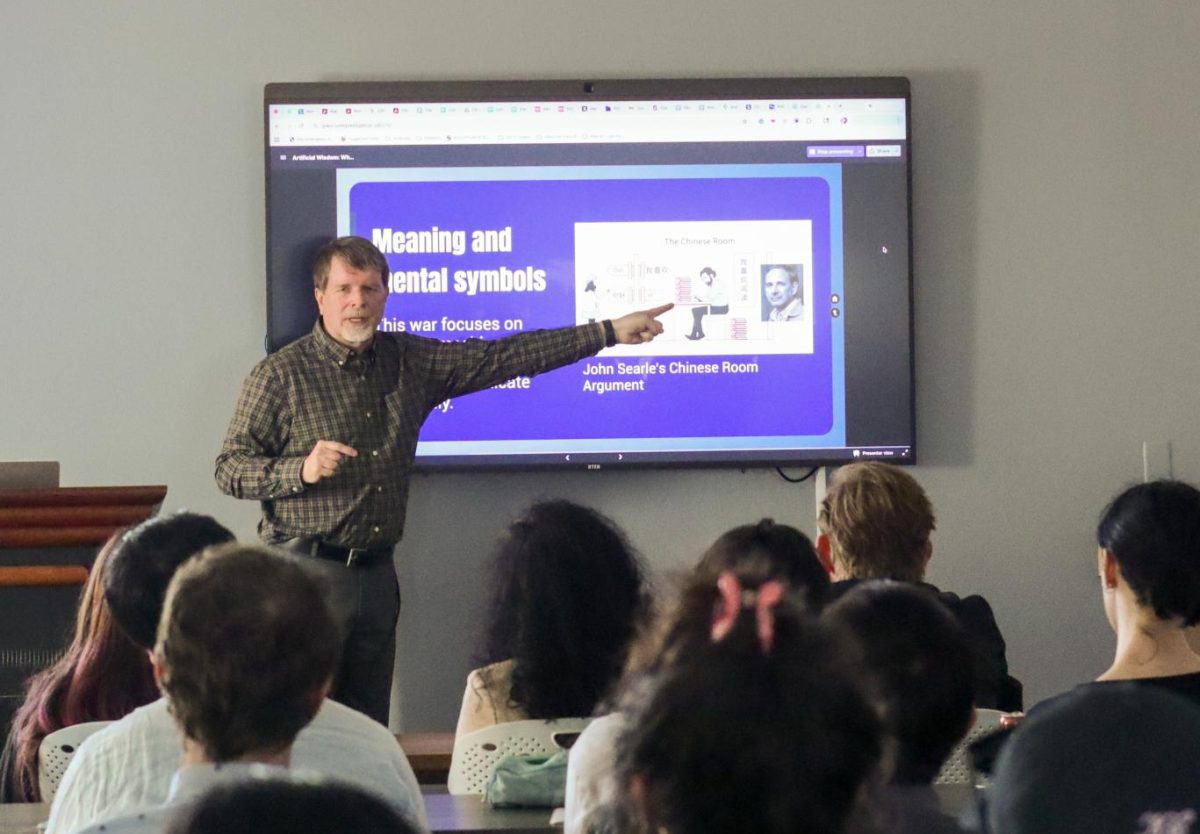
“AI is now actually on the battlefield,” said John Sullins, a Sonoma State University philosophy professor and scholar in artificial intelligence and information technology.
San Francisco State University’s philosophy department held a presentation yesterday as part of their ongoing series to promote the college and the campus with a variety of speakers. Chair of the philosophy department Carlos Montemayor invited Sullins to talk about A.I’s greater ramifications.
Sullins’ presentation discussed the early creation of AI and the fears surrounding it at the time. He made note of the Chinese Room, applying the concept to describe the phenomena of AI technology acting as if it knows or understands what is being asked of it and following instructions to produce an answer.
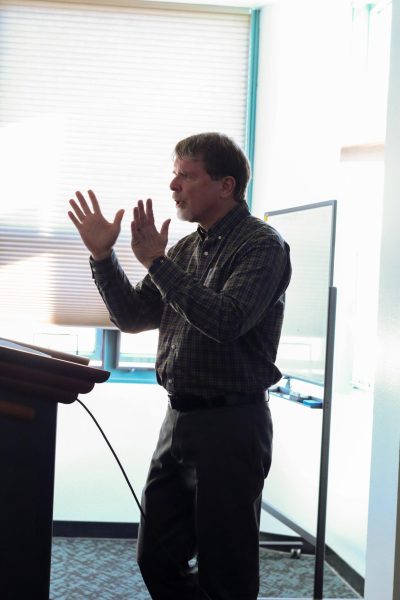
“No intelligence, just behavior,” Sullins said. “Machines act as if they care, but they don’t really. They fake human emotions, they don’t have it.”
As someone who has thoroughly studied and worked with AI for 20 years, Sullins sees both the negative and positive aspects of its use in the modern day.
“Don’t make the mistake of identifying this technology that we have right here in our hands with the term AI,” Sullins said. “It is an aspect of AI. It does some really amazing things but… we created quite the number of social problems that just keep getting worse.”
Montemayor has also spoken up about the negative uses of AI today, writing a book about what AI and technology companies could be doing better.
“Companies are being very hypocritical and they are putting us at risk. They pretend what they’re already doing is helping humanity,” Montemayor said. “If they were really honest and truthful, they will start creating an international framework based on human rights.”
Sullins highlighted individuals such as Elon Musk and Donald Trump as some of the few people who may reap the benefits of current AI technologies.
“It’s like utilitarianism, but with a massive horizon,” Sullins said. “Would you pay 10-15 years of totalitarian government for infinite freedom and good? You’re gonna get your robot body, is that worth just living with robo-Trump for 10 years?”
In Sullins’ opinion, there is a fix to the mistakes of AI today. Artificial Phronesis is a philosophical term for skilled, practical wisdom. It can also be referred to as machine wisdom.
“It [AP] refers to the ability of the machine to engage in practical moral reasoning; AI systems capable of contextual sensitivity in their decision making, although true wisdom requires lived experience, not mere programming,” Sullins said. “The way I see this is these systems do not operate on their own, they operate in tandem with machine-human hybrid teams.”
Sullins’ main theory for the future and advancement of artificial wisdom revolves around humans and AI technology working together, rather than one or the other doing all the work.
“Wisdom remains this uniquely human quality, but I believe it could be enhanced by AI and robotics techniques,” Sullins said.
Sullins says his personal experience with a robotics lab in Italy, where robots helped caregivers aid people with dementia, provides an example on how machine-human hybrid teams can enhance human use of AI without allowing it to completely take over jobs that require humanity.
“A human alone, what happens when they try to give care to the patient?” Sullins said. “What happens when the robot alone tries to give care to the patient? And then what happens when the both of them try to give care to the patient? It seems to work out better with the both of them.”
Despite the drawbacks he points out, Sullins is critically optimistic about the potential of AI. According to Sullins, the rise of AI has intertwined with the common individual’s life as well as increasingly hostile governmental use.
“The philosophical question here is: are we releasing ‘Chinese Rooms’ with machine guns on?” Sullins said.
Montemayor shares the same critique with AI being incorporated into modern day war.
“[AI companies] have been working with the military, as we learned from the Pentagon’s push to use Claude,” Montemayor said.
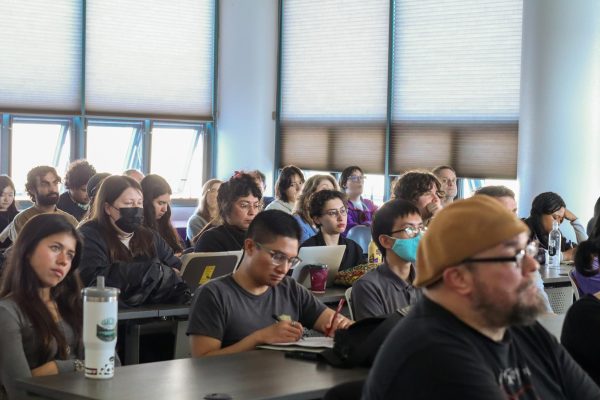
As Sullins presented, the room was full of philosophy faculty and students, waiting to express their concerns about AI usage in the modern world.
Kimbrough Moore, SFSU lecturer in philosophy and computer science, brought up the relationship of usage between top technology executives compared to common users of AI. Moore listed several issues arising as a result of AI, from climate and energy issues to non-consensual porn created by Grok.
“How do you think about the relationship between tech executives who are the ones making these algorithms?” Moore asked. “What is our role as users?”
Sullins acknowledges the likely possibility of AI users who ask for increasingly obscene things from the technology.
“My argument is that they are the ones that get to dictate the grand narrative right now. It’s not fair,” Sullins said. “They just have a lot of power right now. That has to change.”
Catia Mazariegos, a second-year psychology student, was also critical of the technology. If any students or faculty listening to the presentation happened to be in favor of AI, they did not speak up about it.
“Is it really logical to think that far into the future while AI is taking all of our natural resources?” Mazariegos said. “Thinking about the casualties to come with our environment, it can only hold so much.”
Sullins agreed with the damage that is being done with the creation of AI, answering Mazariegos sarcastically. .
“AI accelerationists say AI is gonna figure out how to solve the problem that we just created. We’re playing a dangerous game, and the thing is, none of us really get to have a voice in that,” Sullins said. “It’s going to come at a great cost, to the planet and to us.”
AI has been incorporated in a large amount of humanity. According to Sullins, the best way to approach it is to work jointly with it.
“We spent the last 20 years solving the problem of artificial intelligence, we’ve got to spend some time now solving the problem of wisdom,” Sullins said.




Jill B. • Feb 28, 2026 at 10:30 am
Not sure you can call philosophy professors experts on AI
Jennifer Waller • Mar 2, 2026 at 9:44 am
This particular professor is a leading expert in philosophy of technology and AI. Please take a moment to look up his work.
Jill B. • Mar 3, 2026 at 2:16 pm
He’s an expert on ethics in AI, but not on AI.
Jennifer Waller • Mar 3, 2026 at 6:52 pm
Can you explain to me how one can be an expert on the ethics of a given topic without being an expert in that topic?