





San Francisco Mayor Daniel Lurie joined a coalition of Bay Area transit, business and labor advocates in Dolores Park Tuesday afternoon, kicking off a campaign to qualify a parcel tax measure for November’s ballot.
The campaign that proponents are calling “Stronger Muni For All” joins a regional sales tax push of two prospective sources for long-term Muni funding. Lurie said the variable parcel tax would generate over $100 million annually towards Muni operations as the San Francisco Municipal Transportation Agency’s budget faces an over $300 million deficit beginning in July 2026, purportedly avoiding proposed service cuts that would suspend 20 low-ridership bus lines, double wait times and end regular service at 9 p.m.
With a July 6 deadline to collect over 10,000 valid signatures, Lurie pledged to “work tirelessly day and night” in getting the measure on the ballot and passed in a speech to dozens of its supporters. He concluded his speech with publicly lending his own signature to the petition.
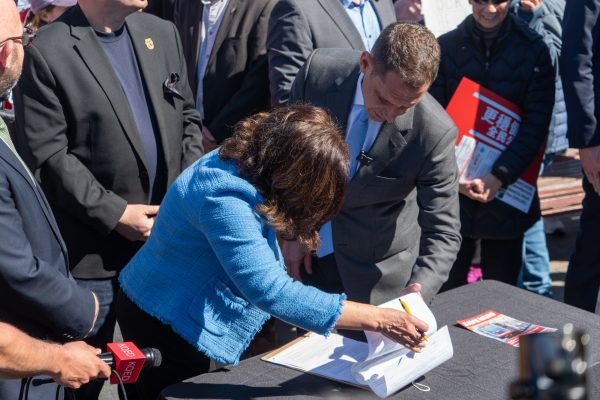
“Muni is the lifeline that connects us,” Lurie said. “The success of San Francisco’s economic recovery is dependent on safe, reliable and affordable public transit.”
The proposed citywide measure would charge most single-family households a flat annual rate of $129, while mixed-use and commercial properties smaller than 5,000 square feet would be charged $799 annually with a $400,000 cap on larger non-residential buildings.
Dylan Fabris, the San Francisco Transit Riders community and policy manager, said the combined efforts of transit advocacy coalitions statewide pushed Sacramento lawmakers to pass AB-SB 117, authorizing $590 million in emergency funds to Bay Area transit agencies as pandemic-era loans dried up. California Gov. Gavin Newsom signed the bill into law in February, preventing the most severe Muni cuts — including route suspensions — for the time being.
“It’s enough time to get us at least to November, probably a little bit further than that,” Fabris said. “Now we’re trying to get these two ballot measures across the finish line to give us more sustainable funding for Muni.”
The second ballot measure Fabris referenced, the “Connect Bay Area Act,” is a proposed sales tax increase of one cent for the City and County of San Francisco and a half-cent for Alameda, Contra Costa, San Mateo and Santa Clara counties, reported to raise nearly $1 billion annually for transit agencies across the region if passed. According to a recent poll by EMC Research, about 59% of registered voters support a regional sales tax to fund transit.
“Each of them alone will only fill about a half of the Muni deficit,” Fabris said. “It’s not one or the other… if you really want to avoid really catastrophic service cuts, people need to vote for the two of them together.”
The event closed with words from the measure’s three chief proponents. Principal Officer of Teamsters Local 665 Tony Delorio spoke directly to Lurie while also acknowledging the endorsement of his fellow labor organizers, including members of the local Transport Workers Union chapter representing Muni operators and fare inspectors.
“Very rarely [are] community, electeds and labor all on the same page,” Delorio said. “This showing of this first event of how we are all together to ensure that this thing passes not by majority… I promise you, Mayor, with my two co-chairs and all labor involved, we are going to put this thing through.”
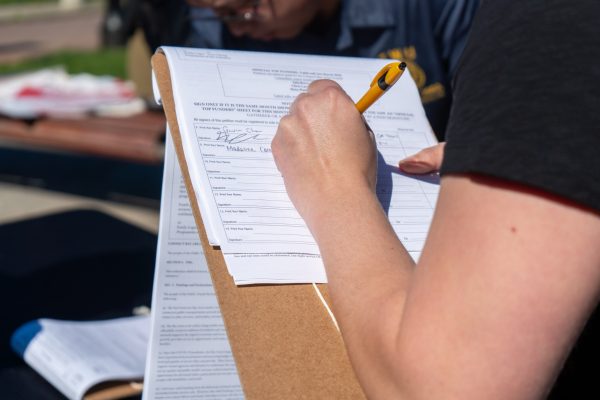
Campaign organizers concluded with a brief signature-gathering training. One of the petitioners, retired City College of San Francisco instructor Tina Martin, has been riding Muni since moving to San Francisco in 1966. Her support for the measure was solidified after seeing how much her friends with limited mobility rely on public transit for a sense of autonomy in their daily lives.
“I actually have a [friend] who has multiple sclerosis, and he says he gets much better around in his mobile device onto the public transport system than he ever could in a car,” Martin said. “If we don’t support our public transportation system, then these people are really going to be without a way to get around…If we care about democracy, if we care about other people, if we care about our community, we need to support Muni.”

William Hough • Mar 5, 2026 at 10:31 am
We don’t need another regressive transportation funding measure. Our taxes are already too high.
Vote NO.
Over the last several elections, voters in Santa Clara County have passed multiple tax and fee increases including gas taxes, the Caltrain Measure RR tax, two bridge toll increases, three VTA sales taxes, Santa Clara County’s Measure A 1/8 cent sales tax, the state prop 30 ¼ cent sales tax and the 2010 Measure B Vehicle Registration Fee of $10,and most recently a Santa Clara County”stealth sales tax.” Additionally, we’re on the hook to pay back numerous state bond issues including high-speed rail, the Proposition 1 water bond and the infrastructure bonds of 2006.
All this nickel and diming contributes into making the Bay Area a horribly expensive place to live; especially for people of modest means, who must pay the greatest percentage of their income in these regressive taxes and fees. Each increase by itself does not amount to much, but the cumulative effect is to add to the unaffordability of the region.
Before increasing taxes YET AGAIN, waste needs to be removed from transportation projects. VTA needs to “value engineer the BART to San Jose project, going with a twin bore tunnel and eliminating the redundant BART extension between the San Jose and Santa Clara Caltrain stations. The BART segment from these stations would duplicate both the existing Caltrain line and VTA’s 22 and 522 buses.
Why don’t the wealthy high rollers at MTC suggest taxing rich tech companies and leave the little guy alone for a change?
Cyrus • Mar 6, 2026 at 3:57 pm
William, how expensive will San Francisco (which is what this article is about, not San Jose or Santa Clara) be when the 20% of households who don’t own a car have to buy one? Have to take Uber and Lyft? How will the economy look when it’s impossible to get into downtown? How will those of low and modest means do when they have to pay $1000 extra a year to deal with parking and insurance?
The local Muni measure progressive: downtown buildings will pay up to $400k a year, while renters and home owners will generally pay less than $150.
After housing, transportation is the second highest cost for most households. Massive cuts to transit agencies will explode that cost further.