

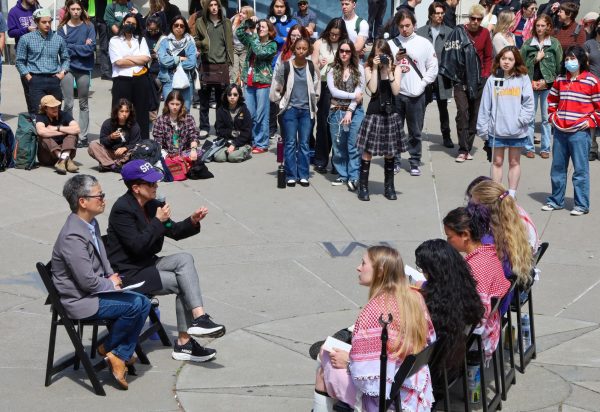
Concerned community members gathered around student representatives and administrators at Malcolm X Plaza on Wednesday to hear negotiations on demands regarding university AI use, campus ICE protocols and problematic funding.
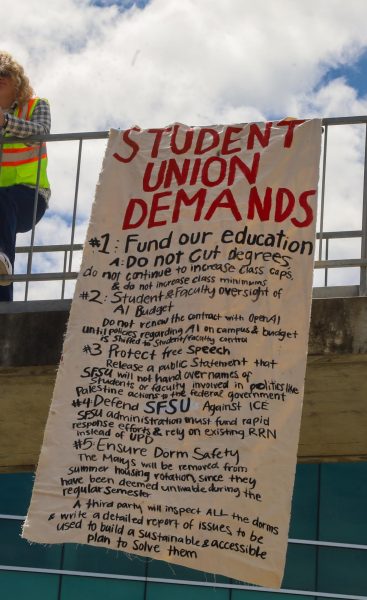
A team of five negotiators from the Student Union represented the San Francisco State University student body to discuss their demands with President Lynn Mahoney and Provost Amy Sueyoshi, demands voted on and ratified by the Student Union two weeks prior during a general assembly. The demands include the reappropriation of university funds to support department diversity, faculty and student oversight of the AI budget, free speech protection, defending SFSU against ICE and properly funding and inspecting student housing to ensure health and safety. On April 15, the student union will hold a general assembly to discuss the negotiations and vote on a course of action.
Kenna Klop-Packel, a mathematics student and member of the Student Union, negotiated proper funding for student’s education. The Student Union is demanding the budget deficit be remedied without further degree cuts or tuition hikes, as well as budget transparency and giving faculty control of course caps — meaning faculty get to decide the size of their courses.
“The other danger about the [course cap] increases is maybe you have a class and it’s had a healthy enrollment of 20 for 20 years,” Klop-Packel said. “If you then raise that course cap to 40, then it looks like that course is half full. But really, that class was designed to have 20 students in it.”
In response, Mahoney said that state and federal funding is declining, but administrators — including herself — are “regularly in legislative offices” advocating for funding for the California State University system, mentioning a recent visit with state Sen. Scott Wiener.
Mahoney also cited enrollment as another reason for the cuts, referencing that lower enrollment doesn’t affect every department the same.
“We are working hard to try and meet the needs of a robust educational experience, but in a context in which there are far fewer students, particularly in some majors,” Mahoney said.
Negotiator and Student Union member Char Bennett has been directly affected by the cuts. Bennett completed their bachelor’s in American studies at SFSU. When they returned as a graduate student in humanities, they were faced with losing lecturers and courses in their department.
“Most of the lecture staff under humanities and American studies were not hired back. They don’t use the term ‘fired’ because lecture faculty don’t have extended contracts,” Bennett said. “This included one of my professors, Sean Connelly, [who] taught in American studies for over 19 years as a lecture faculty… He lost his healthcare [and] job security because of these cuts.”
Bennett also spoke on the demand pertaining to the school providing protection to SFSU community members against ICE. This included abolishing the current protocol, which is to report ICE activity on campus to the University Police Department, and replacing it with a rapid response network within SFSU – with training financially supported by administration.
“UPD’s responsibility is to ensure that Immigration and Customs Enforcement has a judicial warrant,” Bennett said. “UPD will do nothing else beyond ensuring that the warrant is legitimate. That is unsatisfactory to everyone in the Student Union because ICE has been known not to follow any laws, specifically not federal or state laws, specifically not within the bounds of the judicial warrants when they have judicial warrants.”
Mahoney was unwilling to remove UPD as the first responders, but stated that she has tried to get SFSU involved with the San Francisco and Bay Area rapid response networks.
“UPD has to remain our first line of contact in several different ways,” Mahoney said. “First of all, in some areas, folks masquerading as immigration enforcement have shown upland they have no reason to be here and UPD is our best defence for ensuring that.”
Despite Mahoney’s firm stance against cutting university police involvement in ICE incidents, she remained mild on CSU-wide AI policies.
Student and faculty oversight of the AI budget was included in the demands, noting the hefty $16.9 million spent on a system-wide contract with OpenAI since 2025. Shaun E continued negotiations by demanding students not be required to use AI in their offered courses.
Mahoney deflected responsibility of the contract, stating “[SFSU does] not have a contract with OpenAI and I have no control over a system contract.”
Mahoney then suggested creating an ‘AI Bill of Rights’ that the university would create in collaboration with students rather than controlling what professors may or may not require in classrooms. Mahoney also called into question the firm stance against AI and if that is representative of all students.
“I would recommend first [what] y’all do is survey the students because while there is a number who share your view, there are others who would be equally outraged if it suddenly disappeared as a tool,” Mahoney said.
Ramona Lyngen, a political science student who attends SFSU Student Union meetings, saw validity in Mahoney’s call for action while in agreement with all other demands.
“As much as I don’t like AI, I think Lynn is right that the student base, we should talk to them more,” Lyngen said. “I think that in Student Union and in humanities, a lot of us have this very anti-AI mentality and I think that I believe it’s good, I think it’s important that we share that, but I think to be a fair Student Union, we do have to talk to more people about that.”
Tobi Santelices, a visual communications student and organizer in the League of Filipino Students, showed up to support students voicing their concerns. They were encouraged to see so many other peers in attendance, emphasizing power in numbers and democratic organizing.
“Even though our demands weren’t met today, to just see how needed it is to grow the student base for organizing and for democracy,” Santelices said. “With more people, the more pressure will be on Lynn Mahoney and the administration.”
A general assembly will be held by the Student Union on April 15 at 3 p.m. in the quad to discuss proposals in the negotiations.