

A tornado of artifacts splayed across desks of the J. Paul Leonard Library’s fourth floor yesterday demonstrated the depth of the special collections and archives department as it opened its doors to curious students for “Designers in the Reading Room: Engaging with Tangible Artifacts in the Digital Age.”
Not only did the one day exhibition feature paper goods, but witty modern contributions to inspire the integration of future works. Ancient, hefty hardback texts sat in conversation with a hot pink button reading “Bad girls like good contracts,” illustrating the archive’s diversity.
San Francisco State University’s special collections and archives department dates back to the 1960s, with the first formal archive pre-dating the department in 1954.
Since the department’s inception in the 60s, it has remained housed in the library. Despite its history, Meredith Eliassen, a special collections librarian, recalls when the collection became a staffed department in the 1980s.
Eliassen has worked at SFSU for 35 years. Since starting as a library assistant in 1991, she has watched the special collections and archives staff dwindle to a mere six staff members. To her recollection, Eliassen said the department is staffed by three faculty members and three employees.
Despite the department’s small staff, the artifact showcase attracted a steady stream of major-diverse student attendees. Roman Rodriguez, a third-year electrical engineering major, has been working with the Special Collections department for over three years.
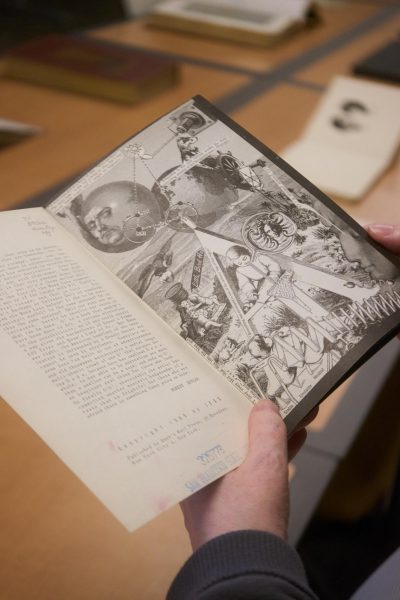
While Rodriguez admitted to holding a bias for the department, he sees the showcase as a fruitful way for his fellow students to embrace their draw to tangible media.
“I found that a lot of students prefer physical books because of the ease of reading. They much prefer flipping through the pages,” Rodriguez said, “It’s just much easier if you own the book to make it your own.”
Gen Z’s attraction to physical media remains in the spotlight as the popularity of vinyl and DVDs has skyrocketed in recent years. As a student, Rodriguez values his professors that prioritize low or no-cost class materials and encourage students to use library resources.
Eliassen credited student’s draw to digital mediums as a result of their fear of failure and the permanence of consequences in the physical space.
“A lot of our students didn’t have childhoods where you could just go out and play and make mistakes,” Eliassen said. “Hurt yourself. Find out the consequences of your actions.”
As students methodically stroll around the room observing the artifacts, Saskia Van Kampen, an associate professor in visual communication design, proudly views her collage work.
In Van Kampen’s seven years teaching at SFSU, she’s witnessed the same fear-centric approach Eliassen described. As a multimedia collage artist, Van Kampen spoke about the role of failure in her own process.
“Eureka moments are a myth. It’s a cumulation of all kinds of knowledge, and all kinds of failing,” Van Kampen said. “You have to fail in order to find something unique and original or different and innovative.”
Both Eliassen and Van Kampen attributed the presence of artificial intelligence as having an effect on students’ confidence. In January 2025, SFSU signed an 18-month contract with OpenAI as a CSU-wide implementation of AI services. As the university comes to the end of its contract in July 2026 with an option to renew, Van Kampen expressed her distaste for AI in the design department.
“I’m dealing with students who are in graphic design, they do graphic design to be creative. AI to them is like, what’s the point?” Van Kampen said. “We’re being affected less by AI in design, but they are using it for the writing”
The presence of AI on college campuses remains contentious as the ethics of artificial intelligence continue to waiver with new developments. Demille Taylor, a design graduate student, recently started working in special collections last semester. Taylor didn’t see AI as a real threat to student wellness, as it falls short of any full replication attempts.
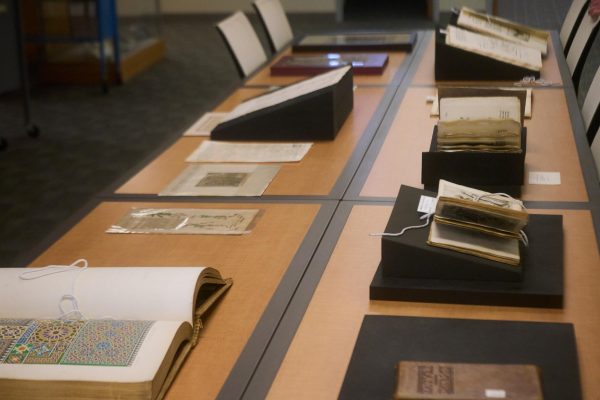
“There’s this push that students and workers need to learn AI because it’s gonna eventually be the standard,” Taylor said. “There’s something really important in taking a step back and looking at human centered design and artifacts. I don’t think human creativity can ever be completely destroyed or replaced.”
Taylor’s humanitarian approach to the use of artificial intelligence directly complimented Van Kampen’s sentiments on uplifting students in specific fields for their needs. While the archive showcase promoted the Special Collections department, it was intended as a showcase for design students to utilize the library’s resources as inspiration.
Van Kampen’s collage work contains a majority of vintage second-hand materials. Everything used to create her collages could be found in the library, with most of the original documents available for photocopy.
With the Trump administration cutting funding to libraries across the country, the J. Paul Leonard Library remains a crucial preservatory sight for university history and beyond.
“It’s really important for designers and creatives to take ownership of their work and understand that even though you’re making something for the moment, this could inspire people for generations to come,” Taylor said. “If there’s something that you’re seeing now, start collecting it, start taking pictures, start understanding.”