

San Francisco State University is expanding the eligibility for the Voluntary Separation Incentive Program to avoid layoffs.
After falling short of enough suitors for the VSIP’s allocated $7.1 million, SFSU will now be adding to the program’s pool of eligible recipients. This includes faculty in the Faculty Early Retirement Program, Pre-Retirement Reduction in Time Base, and 1.0 eligible lecturer faculty in four specific departments to lower spending.
Ingrid Williams, associate vice president of human resources, confirms that this will be the last round of VSIP for faculty members.
“We thought we were not going to have it offered again, and then we realized the predicament we are in with the budget,” Williams said. “The university is making every effort to avoid layoffs.”
Before the VSIP’s expansion, only 37 tenure and tenured-track faculty applied for the program using $3.88 million, just over half of the allocated funds. This would result in a $7.6 million reduction in the 2026-27 budget before accounting for replacement lecturers.
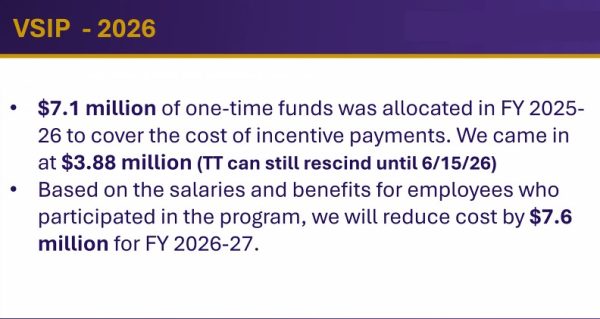
“I want to make it clear that the VSIP is not going to get anywhere close to $7.6 million in savings,” Vice Provost for Academic Resources Michael Scott said. “The dollar figure for people departing isn’t the actual cost savings because some of the instruction will need to be replaced with lecturers.”
Communications studies, English, international relations and philosophy departments were deemed by SFSU to have potentially excess instructional capacity, resulting in the eligibility of 1.0 lecturers and full-time lecturers from the aforementioned departments.
“Instructional needs in these four departments can be met through targeted curricular adjustments and the strategic redeployment of tenure-track and tenured faculty of other departments,” Scott said.
Scott Siegel, associate professor in international relations, believes the transition for non-department faculty would be difficult.
“I think we value everyone teaching here,” Siegel said. “Everyone has their specialty here in the International Relations Department. I don’t think it’s very easy for someone from outside the department to teach international relations courses.”
Fellow international relations associate professor Anthony Pahnke states that the department’s lone full-time lecturer is necessary for students’ education.
“Jonathon Whooley teaches a core set of classes that no one else does in our department, and it’s actually in need,” Pahnke said. “Classes on gender and classes on security, and I don’t know anyone else who teaches those things in other departments. So it would be a problem if he left.”
Though these four departments have been targeted for the VSIP expansion, Scott cannot confirm whether they will be the first departments to see layoffs if the faculty payroll is not sufficiently reduced come fall.
“There needs to be a deep discussion and analysis across the university, so I can’t say any particular department would be targeted or not,” Scott said. “If we cannot sufficiently reduce costs, then the worst-case scenario would be layoffs. Everyone is pulling every lever to make sure we don’t get to that point.”
San Francisco State CSUEU Chapter 305 chief steward Katie Murphy raises the concern of having faculty from other departments replace lecturers.
“There’s concern that people won’t be adequately prepared and that there’s an expertise it takes to teach, say, public speaking,” Murphy said. “Just because somebody’s job is to lecture as part of their course, to speak publicly at conferences, it doesn’t mean that they can teach someone else to do the same. There is an art to it, and it’s an art and a skill that has to be developed over time.”
SFSU President Lynn Mahoney believes Gov. Gavin Newsom’s proposed state budget will sway in the school’s favor, but emphasized tempering expectations.
“It does appear that we have a healthy state budget, but just remember it won’t be final until June or July. At the moment, it looks like we will at least get the governor’s proposal, but we might do better than that.” Mahoney said. “I’m going to encourage we continue to be conservative about budgeting, and we do not take our eyes off needing to innovate, change, and make really hard decisions.”